
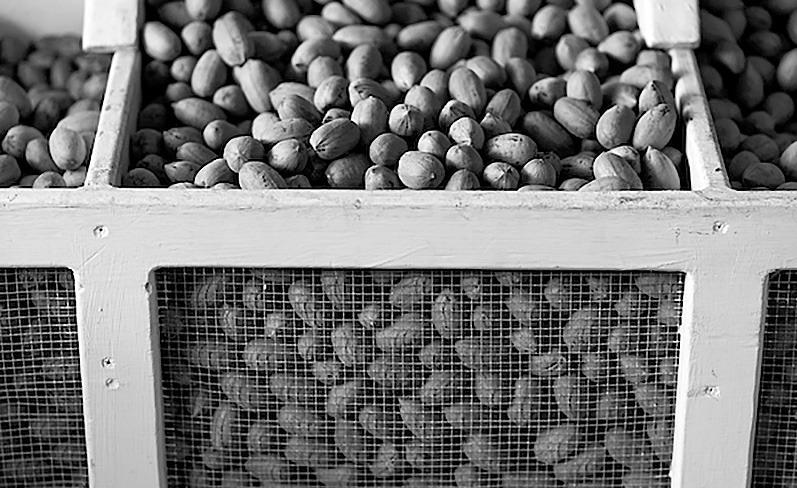
Season-to-season factors continue to keep Texas pecan production from reaching previous yield benchmarks, said a Texas A&M AgriLife Extension Service expert.
Monte Nesbitt, Ph.D., AgriLife Extension horticulture specialist and assistant professor in the Texas A&M Department of Horticultural Sciences, said pecan trees typically produce good to heavy crops followed by a light to very light crop the following year.
But that typical on-andoff cycle pecan growers and homeowners have come to expect from their trees has gotten off track due to a range of factors, Nesbitt said.
“Things are just out of sync, and we’re not seeing the production our 80,000plus acres of pecans are capable of,” he said. “We should be a 50-millionpound producer in a good year, but we’re estimating another year around 28 to 32 million pounds.”
Texas pecan production mixed
The two previous seasons were easier to explain because of drought, Nesbitt said, especially with the extreme heat and lack of rain in 2023. However, this season has presented a mixed bag of conditions – too much moisture for some Texas orchards and not enough for others – that will lead to another subpar statewide yield.
“There are locations that look good, where the nut crops look moderate to moderately heavy, but they’re dispersed around the state,” he said.
In the eastern half of the state to south Central Texas and down to the Gulf Coast, early spring moisture hurt as much as it helped by setting the stage for disease, Nesbitt said.
Scab, a fungal pathogen and the most economically damaging disease pest in pecans, is front and center among a range of diseases that could impact yields and quality for many orchards.
Nesbitt called 2024 the worst manifestation of scab he’s seen in years. The disease’s presence will impact at-home producers as well as commercially managed orchards, where disease control practices were hampered by the weather.
On the other end of the moisture spectrum, pecan orchards in the Panhandle and High Plains down to El Paso continue to deal with drought and/or water restrictions, Nesbitt said. In those regions, the on-andoff cycle for trees has not aligned with growing conditions and water availability.
For instance, growers around El Paso received a water allotment increase this season compared to last but are not expected to have a bumper crop because it is an “off” year for most trees, he said. The previous season was vice versa.
“Last year, those orchards had good production from the trees, but the water situation was not good,” he said. “This year, they have the water, but it’s not a big cropping year. They need water consistency to reach each season’s potential.”
Potential for pecan demand
Poor wholesale pecan prices have exacerbated economic challenges for growers, Nesbitt said. Low prices have plagued the U.S. pecan industry since the pandemic after a good run of years with high prices prior to that global event. Poor prices, so-so yields and cost increases on inputs like fertilizer, fuel and labor have been difficult for many growers.
Blair Krebs, executive director of the Texas Pecan Growers Association, said wholesale prices improved some – about 20-30 cents per pound – last year, but that it is too early to guess how they will respond to supply and demand factors when harvest is complete.
A few demand-side factors may improve the market for growers in the future, she said. Mars Inc. has announced it will make a highly successful test run of pecan Snickers — a permanent fixture in its candy lineup.
The pecan industry is also seeing positive movement on potential export demand. Industry representatives were working to reestablish better trade with China where high tariffs on pecans devastated years of export gains there. Popularity of the nut in Chinese markets had boosted domestic prices significantly before the trade rift.
India is also emerging as a potential growth market for pecans, she said. Industry representatives had been working to reduce high tariffs and were successful at negotiating a 70% reduction. Krebs said progress there will likely be slow, but that the large, young population presents a considerable opportunity for growers.
Meanwhile, Nesbitt said Texas pecan growers continue to realize strong prices for direct-to-consumer and direct-to-retail markets.
- Log in or Subscribe to post comments.