
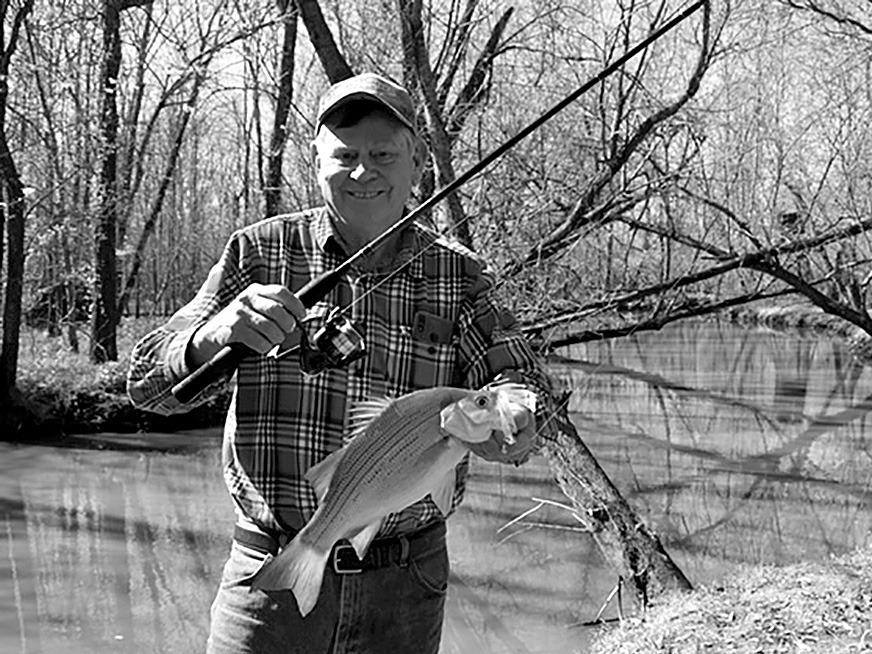
I was well into my twenties when I first began fishing for white bass, or sand bass as they are called in north Texas. Sand bass flourish in lakes with feeder streams and each spring make spawning runs in the creeks or rivers. This provides one of the first fishing events of the year for many anglers. But white bass can be caught in abundance year-round with a bit of knowledge of patterns.
The farm ponds and small lakes I grew up fishing in northeast Texas simply didn’t have sand bass, and I was somewhat of a late bloomer when it came to fishing for them. We fished for fun and food back in the sixties, and catfish, largemouth bass, or crappie sizzling in a cast iron skillet was the reward of a successful fishing trip. Notice I didn’t say ‘fillets’. The smaller fish we scaled and fried whole; the larger ones my dad ‘steaked out’ by simply cutting them into chunks, bone and all!
Back in the seventies, when I first began fishing our larger lakes, I discovered a new species (for me): the white bass. My career as an outdoors writer was just beginning, and the guides I fished with used an electric knife and filleted the fish, a method that I soon adopted. I grew up eating fried fish with bones and loved cooking and eating these boneless pieces of fish. I soon began filleting everything from bluegill to catfish.
Some old-timers back in the day shunned eating white bass because of what they referred to as the ‘off taste’ of the red meat on the side of the fillet. I quickly learned that smaller white bass have very little of this red meat, and a light touch with the fillet knife easily removes this ‘bloodline’ on the larger fish. I learned to tilt the knife blade up a tiny bit when filleting the skin side of the white bass which leaves almost all the red meat on the skin. Thirty minutes marinating in a solution of Louisiana Hot Sauce and buttermilk gives the fillets an even better flavor, but I also enjoy them right out of the lake/creek and into the skillet.
This past week, I joined my friends Jeff Rice and guide Brett Kilmer with Chums on the Water Guide Service for a few hours of red-hot white bass catching on Lake Tawakoni. Brett and his partner Casey Laughlin are both veteran fishermen that decided to team up earlier this year and offer guided trips on both lakes Tawakoni and Ray Hubbard. They operate out of Anchor Inn Marina, a place that holds many fond memories for me and where many fun fishing trips began through the past years. A few weeks ago I joined the guides for a live bait hybrid striper trip on Tawakoni and knew I was in the boat with a couple of very knowledgeable fishermen. Both obviously had a passion for fishing and had every bit as much fun as I when one of the big hybrids decided to snatch one of our live shad offerings and head for the distant shoreline!
When Brett called last week and informed me that sand bass catching had been as dependable as the polar star, I was all in. There are all types of fishermen; some fish exclusively for crappie, others largemouth bass, stripers, or catfish. I like to catch anything that pulls on the line and tastes good when dusted in cornmeal and exposed to hot cooking oil or blackening seasoning. I do draw the line with carp! Well-seasoned white bass fillets fried to a golden brown are one of my favorites, and when Brett buried his head in his sonar, studying the bottom structure on the side of a long submerged point, I noticed thick pods of fish stacked vertically from the bottom up for several feet. Sand bass, and in a feeding pattern!
For the next couple hours, it was game on! Brett uses side imagining sonar rather than the currently popular forward-facing sonar. I also like this system. While forward-facing sonar gives a real-time picture of what’s below, as well your bait in relation to the fish, I find it annoying and somewhat frustrating to keep my eyes glued to the graph, especially on bright days when the screen can be difficult to see. It works well for one fisherman, but sand bass fishing is often a team event with several fishermen in the boat. Just get me over the fish, and I’ll take it from there! As Brett slowly motored over the point, he pointed out scattered schools of white bass on both sides of the boat. But soon a big cloud that resembled an inverted tornado plotted off to the right of the boat. We were soon positioned precisely over this huge ball of sand bass and bait; spot lock was activated which kept the boat perfectly in place.
Sand bass can be caught on a wide variety of baits, but it’s hard to beat a lead slab as an all around fish catcher. Almost all our fish came within a couple feet of bottom. Brett says when he’s looking for fish, he seldom pays much attention to suspended fish that show up in the water column. “Occasionally, I’ll spot schools of fish chasing shad close to surface,” says Brett. ”These are often top water fish that will give their location away when they break the surface. I’ve learned that paying attention to the bottom is the key to consistently locating schools of actively feeding fish.”
Another trick that Brett uses is a trolling-mounted splasher that churns the water’s surface. I learned long ago that schooling white bass and stripers are attracted to splashing on the surface that emulates feeding fish, and it often puts them in the feeding mode. At one point we had a couple other boats in sight. The guys were using slabs just like us but only occasionally catching fish. The prop churning water on the surface was obviously one of our aces in the hole, another was a stinger jig about 18 inches above the slab. The use of jigs above slabs is nothing new; sand bass anglers have been using this technique for years, but Brett has his own system of attaching the jig to the line. He slides a tiny 1/32 oz. white feather jig onto the line just above a swivel. An 18-inch leader is tied to the other end of the swivel and the half-ounce slab tied to the tag end. I never understood why the majority of white bass pass up the larger slab and strike the tiny jig, but they do. We caught the majority of our fish on the little jig. Some sand bass fishermen troll with big deepdiving plugs, such as the Hellbender, with a tiny Pett spoon trailer a couple feet behind. I guess the movement caused by the big plug triggers the strike, but the fish hit the tiny silver spoon.
Sand bass provide a great deal of sport and good eating for anglers across much of the country. What more could we fishermen wish for? A species that is plentiful, and with just a little knowledge, often easy to catch! Long live the white bass!
Email outdoors writer Luke Clayton through his website www.catfishradio.org.
- Log in or Subscribe to post comments.