
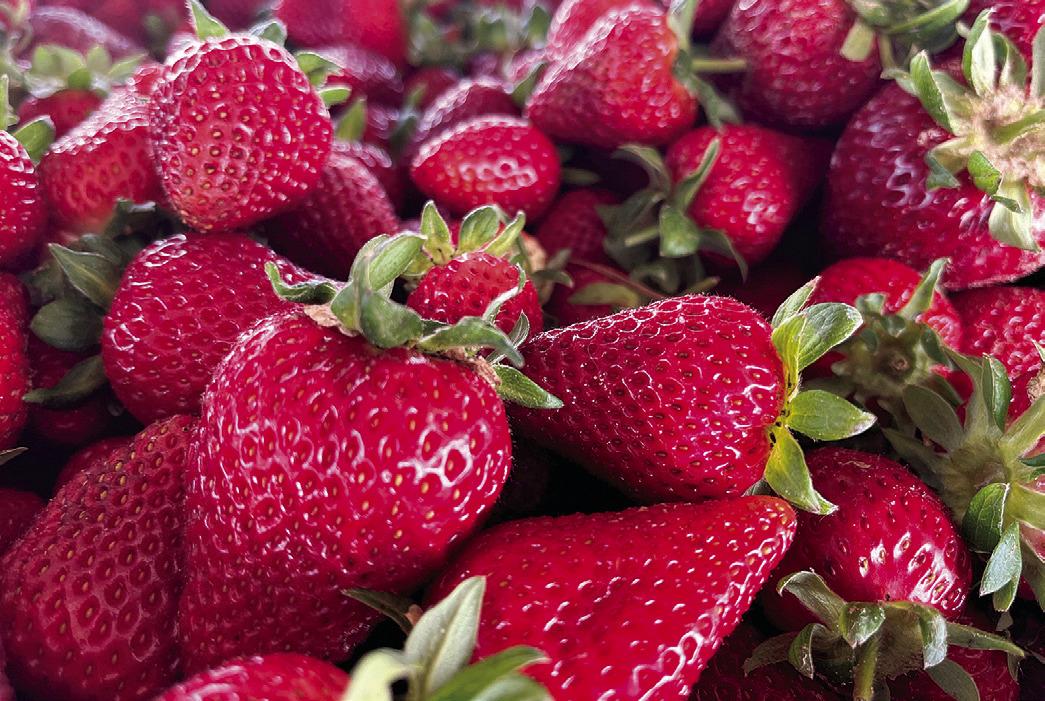
Texas strawberry growers have enjoyed an early start to their season and the crop looks fantastic so far, according to a Texas A&M AgriLife Extension Service expert.
“This year, the season started earlier than it has in the past three to four years, and perhaps by as much as two to three weeks,” said Russ Wallace, Ph.D., AgriLife Extension horticulturist and professor in the Department of Horticultural Sciences, Lubbock. “The first berries to come out of the field were large and very sweet, and the quality has been excellent.”
Part of this season’s strong crop is thanks to a milder than usual winter for many growers. Freeze damage to the flowers and plants has been minimal, Wallace said, and growers who protected their crop with row cover cloth saw less damage and earlier production than others.
Wallace said he has been impressed with what he’s seen so far.
“This spring, I’ve traveled across the state visiting growers’ fields, looking at the strawberry crop,” he said. “The crops overall look fantastic and the weather, for the most part, has cooperated.”
Although some regions get more fruit per plant, in Texas the average is about 1 pound, Wallace said. But given the favorable growing conditions, those larger berries should translate to increased weight per plant, making for a good season for most growers.
Inclement weather has impacted some individual strawberry fields, he said.
“There have been some heavy rains at some locations, as well as a few hailstorms, which damaged some crops,” Wallace said. “The heavy rains caused an increase in fruit diseases like botrytis gray mold in those locations and those berries needed to be removed from the fields.”
The losses to weather were slight and not enough to impact overall prices or production. He said typical diseases and insects have been kept in check with conventional and organic control best practices and should not be a major factor this season. He added that Texas’ strawberry crops tend to be treated for diseases and pests very little compared to other states.
Wallace also said he had not heard any concerns from growers this season related to drought. Watering strawberries is very efficient because strawberries are planted on raised beds with plastic film, and irrigation drip lines run on or below the surface under the plastic.
Increasing demand from consumers
Wallace said he believes strawberry acreage in Texas will continue to increase as growers see high consumer demand and the crop’s profitability. He said he is encountering more farms that have recently added strawberries to their overall production.
“For the past two years, my colleagues and I have been evaluating up to 20 strawberry varieties to determine whether there are better options than the current ones,” Wallace said. He said they collaborate with 15 growers statewide and several new varieties look promising.
Prices are excellent for growers for the most part, he said. Farmers offering “pick-your-own” strawberries are charging between $3.50 to $8 per pound, which is roughly the same price as last year. But given the favorable growing conditions this year, many producers may have more strawberries to sell.
Wallace said while he has not seen an uptick in prices, it is possible producers could charge more money per pound because of intense demand in some areas. The popularity of Texas strawberries is so intense that some “pick-your-own” farms can be harvested out within several hours.
“Sometimes customers are turned away,” he said. “That just demonstrates the need for more growers and more acres dedicated to strawberries in Texas.”
What consumers should know
Wallace said strawberry consumers understand that locally grown Texas strawberries are a premium crop – in both price and quality. It takes a significant amount of work and money to produce strawberries, and the harvest season is relatively short at just six to eight weeks.
Around 90% of U.S. strawberries come out of California and Florida, but locally grown strawberries typically have a better appearance and flavor because they are picked and sold daily and not shipped across the country, he said. Texas strawberries are picked at a stage when they are fully ripe and the ideal shade of red, which is not what you generally see in large retail chain stores.
Unlike some other fruit, strawberries will not ripen any further once picked. Berries should be at least 80% red before being picked but 100% is ideal to ensure the best taste. Very dark berries, on the other hand, but otherwise unblemished may be overripe but can be used for jellies, jams and cooking.
“Texas strawberries are in high demand and demand a premium price because consumers know what they are getting,” Wallace said. “A lot of folks are repeat customers, and they want the best quality. They want the ripe red and the sweetest taste, and you can only really get that from growers in your area.”
Celebrate strawberries Poteet, south of San Antonio, has the state’s largest concentration of producers and is considered the “strawberry capital” of Texas, but other producers can be found in the Dallas-Fort Worth, Houston, Austin, Lubbock, Tyler and Fredericksburg areas.
If there are no local growers, look for berries grown in Texas when shopping at the supermarket. If you want to try a bunch of different berries, consider heading to Poteet, April 12-14, for the annual strawberry festival, which began in 1948. Visitors can taste and buy berries from local producers as well as enjoy live entertainment and a carnival.
“We’ve had a great crop so far this year,” said Joel Garcia, 4G Reyes Farms and president of the Poteet Strawberry Growers Association. “I’d encourage all Texans to enjoy local-grown berries while they can and to come down to the festival to experience everything strawberry-related as well. It is a very neat festival for such a small town.”
Garcia said all produce sold on the festival grounds are authentic Poteet strawberries, and all the food vendors at the event, from beer to brats, benefit non-profit organizations.
“We had some hailstorms limit some of our area’s growers for a few weeks, but the weather has cooperated since then with plenty of sunshine to let the berries come into fruit very nicely,” Garcia said. “Overall, this is a very good year for the industry here so far, and we’ve been able to keep those perishable strawberries on the vine until they are ripe and perfect to pick.”
- Log in or Subscribe to post comments.