
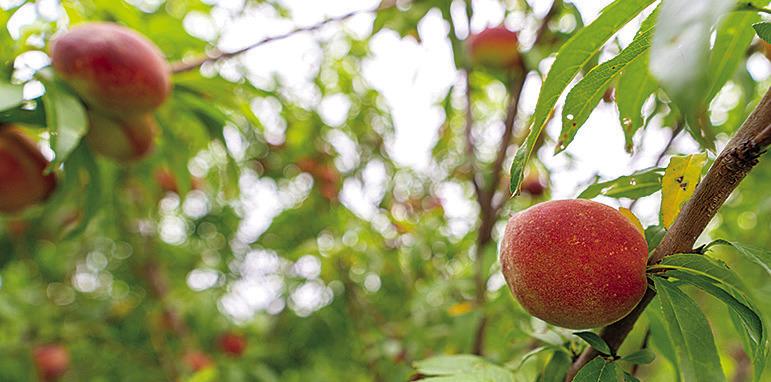
While it is too early to tell about the impact of chill hours for fruits grown in higher chill areas of the state, current conditions are good for the lowto- mid chill areas, said Texas A&M AgriLife Extension Service experts.
The importance of chilling out
Larry Stein, Ph.D., AgriLife Extension horticulturist and professor in the Texas A&M College of Agriculture and Life Sciences Department of Horticultural Sciences, Uvalde, said fruit trees like peaches and apples depend on cool, cloudy weather in the winter to promote proper physiological growth in the spring.
Stein said fruit growers in most areas of the state were “cautiously optimistic” that chill hours and other conditions are and will continue to be favorable for this year’s fruit crop.
Fruit growers in differting ent regions of the state have plants with different chilling requirements, he said. Orchards along and near the Gulf Coast might have trees that require 200-300 chill hours, while trees in the Winter Garden region need about 400-500 hours, and varieties in the Hill Country and North Texas might require 7001,000 hours.
“If plants do not receive the required number of chill hours, they can be slow to leaf out, which typically leads to poorly developed fruit or no fruit at all,” he said.
Stein said chill hours begin to add up after the first freeze each fall. Trees go dormant for the winter, but chill hours promote hormones that dilute growth inhibitors throughout the winter and prepare the plant to break dormancy and begin new growth, bloom and set fruit.
Typically, temperatures between 32 degrees and 50 degrees can meet the chilling of many fruit plants, with the most effective temperature range being 32 degrees to 45 degrees.
Seeing doubles
Stein said chill hours have been sufficient in the mid-tolow chill areas, but were marginal in the higher chill areas, with a lot of growers reporting “doubles” on plant blooms.
Doubles, also called conjoined fruits, are not an uncommon occurrence, especially in stone fruit, with some fruit varieties more prone to it than others.
“Doubles or multiple fruit come about as the result of stress during the flower initiation stage, which would have been May and June of 2023,” he said. “These doubles seem to be the consensus when talking to area producers, with some saying they are getting three and four fruit from a single bloom.”
Irregular or inadequate watering has also been identified as a likely cause of fruit splitcome and doubling.
“Consumers usually consider conjoined fruits less visually appealing,” Stein said. “For producers, sometimes the extra piece of fruit is so small as to be insignificant and can be safely removed without harming the main fruit. To avoid the conjoined fruit, producers typically thin their fruit trees to get as many double or multiple fruits back to singles as possible.”
Growth regulators and climatic conditions Jim Kamas, AgriLife Extension fruit specialist based in Fredericksburg, said many fruit growers in the Hill Country and Central Texas, where chill hours were marginal, have benefited from the use of a chemical growth regulator that mimics chill hours.
“This helped the fruit plants to overcome insufficient chilling, and the extra effort and expense for these producers paid off,” he said.
The use of these growth regulators helped many producers get to this point, but Kamas said the real elephant in the room when it comes to overall fruit production is drought.
“We are hearing that our brief and disappointing El Niño event is over and that the forecast is to be hot and dry,” he said. “The soil moisture is currently adequate for fruit crops as the fruit trees develop and expand canopy, but as the temperatures berequirements warmer, drought could soon become a problem for producers.”
If the hot, dry weather arrives early, fruit producers may be at risk for lower yields, misshaped fruit with lower market appeal, and possibly delayed or inconsistent harvests.
“They also have to hope that spring thunderstorms do not hinder the progress of their fruit production,” he said.
- Log in or Subscribe to post comments.