
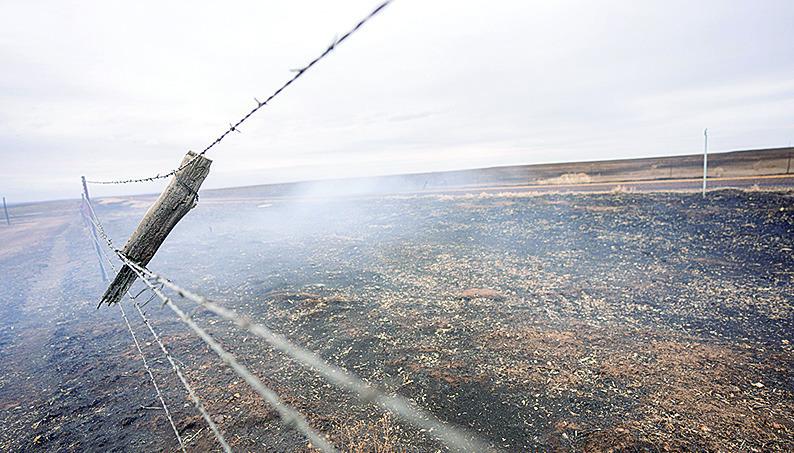
An overwhelming task lies ahead for ranchers whose pastures and ranchland were burned by the wildfires that left thousands of miles of fencing to be repaired or replaced.
Texas A&M AgriLife Extension Service beef cattle specialists Jason Smith, Ph.D., Amarillo, and Ron Gill, Ph.D., Stephenville, said producers should begin by focusing their efforts on perimeter and boundary fences and viable pastures with water sources.
Interior cross fences can receive less priority as they can be temporarily constructed as needed.
“Prioritize fence repair and replacement in pastures with functioning, reliable, longterm water sources,” Smith said. “Fences in pastures with only seasonal or surface water, or with wells that require repair before they can pump water again should receive lower priority and be repaired or replaced after fences in pastures with more reliable or functioning water sources have been mended.”
Repairing and replacing fences with a purpose When considering what fences to replace, Smith and Gill said ranchers should keep in mind that fencing age influences the breaking strength and elongation potential of 12.5-gauge zinc-coated barbed wire.
A study by Oklahoma State Universityshowedthatfiredid not affect breaking strength and elongation potential, regardless of the discoloration of the burned wire. The zinc coating remained. These effects held true through six separate fires included in the study’s experiment.
Rebuilding fences: Specifications could matter Some ranchers may be looking into programs through the U.S. Department of Agriculture, USDA, Farm Service Agency, FSA, that may be available to assist producers who suffered losses on their land or with livestock and fences due to the fires.
The Emergency Conservation Program, ECP, provides emergency funding and technical assistance to farmers and ranchers to rehabilitate farmland and conservation structures damaged by natural disasters and implement emergency water conservation measures during severe drought. One qualifying practice is restoring fences on agricultural land — livestock cross fences, boundary fences, cattle gates or wildlife exclusion fence.
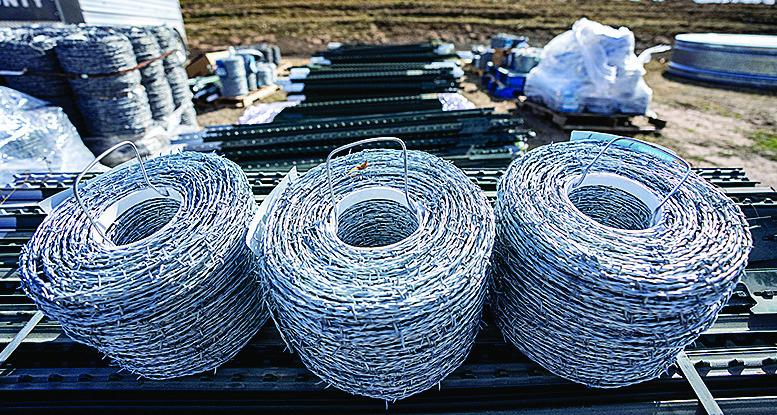
Building fences that may qualify for federal funding will require meeting their specifications, so these may be things to look for when buying or picking up donated materials. Keep all receipts for documentation purposes if a government program could be used or for insurance purposes.
Wire
•Barbed wired must meet ASTM-A121
•Smooth High Tensile wire must be 12.5-gauge, 1,300-pound break strength, tensile strength exceeding 170,000, and be Class III galvanized or above.
•Wire clips must be galvanized and match or exceed fence wire strength.
T Posts
•6 feet, not less than 1.25 pounds per foot galvanized or painted Pipe
•Steel 2 3/8 inch minimum, but bigger is fine.
For more details or information on any government program participation, contact your local USDA-FSA or USDA-NRCS office.
Donating fencing materials Several Animal Supply Points are set up through AgriLife Extension and fencing materials have been identified as a primary need. Those who are planning to donate fencing supplies should follow the specifications identified by USDA.
To donate, contact the following supply points and coordinators: East Location Animal Supply Point: Clyde Carruth Pavilion, 301 Bull Barn Drive, Pampa. Contact Marcus Preuninger at 806-669-8033.
North Location Animal Supply Point: Canadian AH&N Ranch Supply, 100 Hackberry St., Canadian. Contact Andy Holloway at 806-323-9114.
West Location Animal Supply Point: Industrial Park, 407 Industrial Blvd., Borger. Contact Hanna Conner, 806-8784026.
- Log in or Subscribe to post comments.