
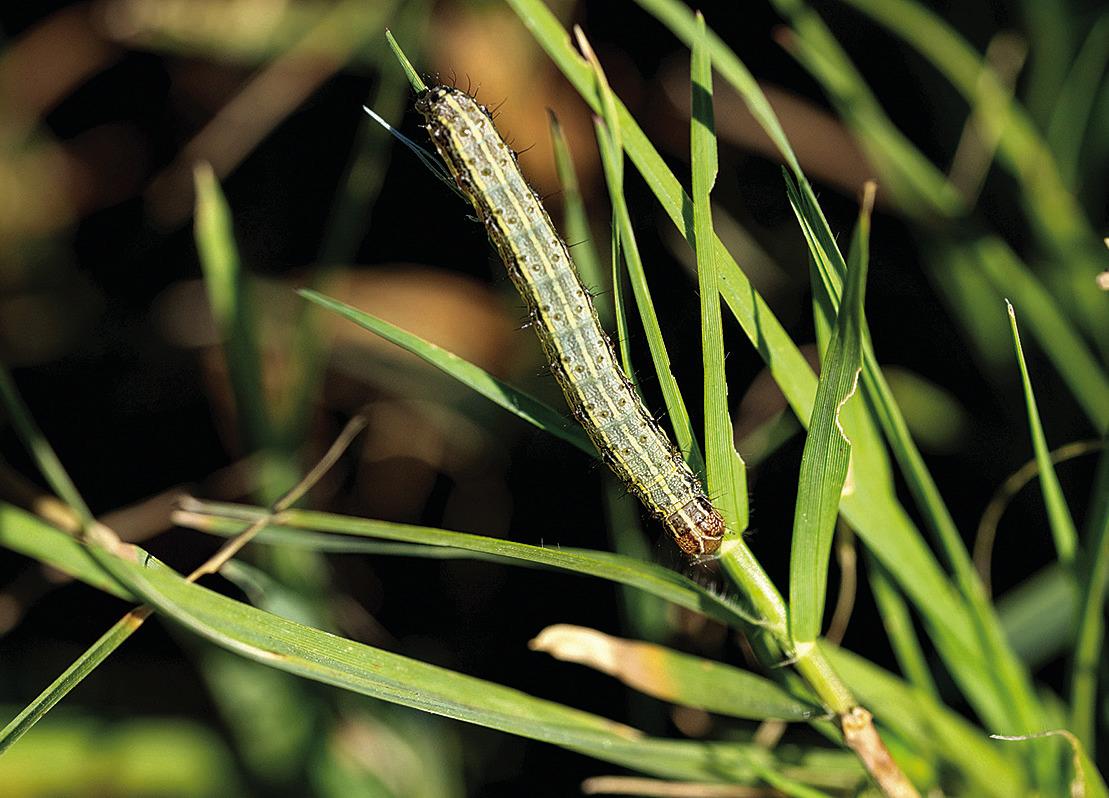
Many producers throughout Texas are noticing an increasing fall armyworm population in their rangelands and forages in areas after receiving rainfall over the last few weeks. Texas A&M AgriLife Extension Service experts recommend producers be prepared to protect their valuable forages.
Vanessa Corriher-Olson, Ph.D., AgriLife Extension forage specialist and professor in the Department of Soil and Crop Sciences, Overton, said the most important thing for producers right now is to realize the areas receiving rain will see grass growth that could fuel armyworm populations. Damage from infestations could be problematic for cattle operations dealing with short hay and forage supplies due to drought.
“Armyworms can be picky eaters,” said Olson-Corriher. “These insects are going to select well-fertilized or irrigated forages to feed on.”
Scouting valuable forages for armyworms Forage producers planting cool-season forages, such as winter wheat, annual ryegrass or any small grains, are at higher risk of armyworm infestations. Young seedlings are subject to more damage than more mature perennial warm season forages.
Scouting is the most effective way to know if you’re dealing with armyworms and deciding how to manage populations.
“After a rain, producers should walk through their fields at dawn, when armyworms are most likely to be active and see if the population size warrants treatment with an insecticide,” Corriher- Olson said.
Producers should be looking for armyworms that are green with brown or black colorations and are identified by the white inverted Y on their heads. Mature armyworms can grow up to 1.5 inches in length.
Controlling armyworm populations When scouting forages and seeing a spike in armyworm population, if there are more than three armyworms per square foot, producers are advised to determine which insecticide to spray and do so immediately.
“Most producers keep insecticides on hand that are labeled for different scenarios,” said Corriher-Olson.
David Kerns, Ph.D., AgriLife Extension state integrated pest management coordinator and professor in the Texas A&M Department of Entomology, said the bigger the worm, the more they can eat. “If you have a large population of large larvae, you’ll need to handle them immediately because they can consume an entire field overnight,” Kerns said. Most producers are likely to use a pyrethroid insecticide due to the low cost, but that might not get rid of the majority of the population because they only last up to five days. Additionally, the armyworms must be directly exposed to the pyrethroid by touching or eating the plant.
“We have translaminar pesticides that soak into the leaf tissue of the plants,” Kerns said. “This means it lasts longer and the rain won’t wash it off, but the translaminar pesticides are higher in price.”
He added that a year like this that has been droughty “is going to suppress the armyworm population but be on the lookout for armyworms since the recent rain gives them something to build on.”
- Log in or Subscribe to post comments.