
This past week, I was on the phone with my friend Michelle Wohlberg, doing an interview for my outdoor radio show. Michelle was in northern Saskatchewan where she is camp manager for Western Trophy Outfitters. Fall bear hunts are underway, and the first ‘stop over’ geese have just arrived. Her camp is on the southern edge of the Boreal Forest, where the wilderness stops and the farmland begins. Geese fatten up on the grain fields before heading south and eventually make their way to Texas. Michelle informed me to get ready for cooler temperatures; the first Arctic blast of the season had dropped the temperature to near freezing at night there at her camp and the cold air was headed south. Here at home in midafternoon, the thermometer was pegging 105!
Sure enough, Michelle’s prediction was right on target. Earlier last week, we felt our first taste of very welcome cool weather. Granted a low in the sixties at night cannot be construed as ‘chilly’ but it is a taste of what’s to come and we welcome it, right?
The cool weather prompted me to spend more time practicing with my bow and scouting the woods near my home for archery season, which is only a couple weeks away. One of my trail cameras evidenced a very nice ‘non typical’ old buck that is still running with his bachelor herd. He is past his prime, and the kind of deer I like to harvest. His antlers are still impressive, although not what they were a couple years ago. He venison will be excellent and as we old deer hunters
say, “You can’t eat the horns”! In another month or so, these groups of bucks will begin to disband. The whitetail rut will be in its early stages, and buck deer will no longer be running buddies. They will become enemies and compete for breeding rights to does during the peak of their breeding season. Fights among mature bucks are often intense, and chances are good some of them won’t survive to once again regroup after the rut.
From all that I can learn from my scouting trips, this should be a very good fall/ winter as far as deer food is concerned. The oaks and pecan trees where I hunt are sporting a bumper crop of pecans and bois d’arc trees are loaded with horse apples. Acorns have already started to hit the ground and, by the time bow season opens, my corn feeders will all but be abandoned by deer. Acorns are a favorite deer food, and I learned long ago that acorn bearing oaks are the ticket to early bow season success. I always think of the fruit of bois d’arc trees as nature’s way of supplying late winter food for a wide variety of animals. Have you ever noticed that when horse apples turn yellow and ripen on the ground, every critter in the woods it seems eats them? They ‘winter’ well, even laying on the ground, and supply food when all the hard mast crops like acorns and pecans have been eaten. The leaves of the bois d’arc trees are a favored food of whitetail deer. Next time you are in the whitetail woods, take a close look at bois d’arc trees. It’s a good bet every leaf will be picked clean as far up as deer can reach.
Locust trees are despised by many because of the sharp thorns that can be blamed for many a flat on ATVs or pickups, but the bean pods the trees produce are another natural food that deer love. The pods ripen on the tree and become very sweet, thus the name ‘honey locust’. Black locust, another locust species, also has sweet pods but not quite as sweet as the honey locust. I’ve had success in years past hunting around locust trees, especially in late November and December when the pods have ripened and the thick substance inside becomes very sweet. I’ve watched deer and wild hogs rearing up on the trunk of locust trees in order to reach the low hanging pods. Next time you are around a locust tree in late fall, pick a few beans to chew on while you are waiting for your buck. Chances are good you will enjoy the flavor every bit as much as the deer do!
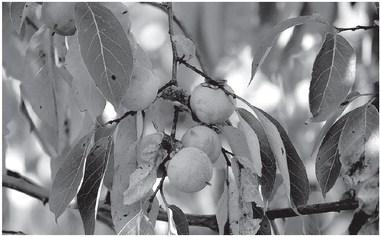
There appears to also be a bumper crop of persimmons this fall. There are persimmon trees in the woods around home where I hunt, but not many. I know the location of most of them and often set trail cameras on their trunks to monitor deer and hogs. I truly believe all wildlife prefer persimmons to every other natural food. The fruit of the tree is full of alum and ‘puckers one’s mouth’ when eaten green. Even wildlife shuns the green fruit, but when the first frost hits and the persimmons ripen and fall, they are gobbled within a few hours. I used to spend time around a guy that devoted a freezer to ripe persimmons. He used them to attract hogs to his traps and swore there was no better natural bait. I am planning on gathering some ripe persimmons and planting them along the wood line of the land around my home. Persimmons are fast growing trees and can bear fruit in as little as five years. According to folklore, if you crack open a persimmon seed from a ripe fruit and the shape inside (called a cotyledon) looks like a fork, winter will be mild; if you see a spoon, there will be a lot of snow, and if there is a knife, winter will be bitingly cold and “cut like a knife.” I seriously doubt the interior of a persimmon seed is a reliable method of predicting weather, but as a boy I cracked open many a seed and would be delighted to discover the fork, knife or spoon!
Should you be up in northeast Texas around Greenville on Saturday October 14, consider joining me at the first annual “Get Outdoors” event to be held on the grounds adjacent County Armory, 2510 Hemphill St. This should be a great celebration of the outdoors with all sorts of vendors on hand. For more information, call Ehren Beckwith at (903)259-6600.
Contact outdoors writer Luke Clayton through his website www.catfishradio. org.
- Log in or Subscribe to post comments.