
It might be hard for some to believe that DINOSAURS roamed anywhere in Texas, but proof is just about indisputable…..
Yes, I have been to museums and seen individual bones with labels and even reconstructed skeletons lying long and standing high, with descriptions of what they are and from whence they came; however, most of these had been found in other states or countries and transported here for our educational viewing.
Yes, I have seen what were described as dinosaur tracks in the “shale stone” areas of Oklahoma when I was a boy, and they looked very real to me at the time in State Parks.
Yes, I have seen BONES, described as from various pre-historic animals, in numerous museum cases in Texas and other states, and, I have seen the tracks at Glen Rose State Park (as has at least one, maybe more, of my sons.)
And, yes, I have heard the stories of farmers, plowing up “dinosaur” bones and pre-historic relics—some I semi-believed, and some I discounted as the recollections of “old-timers” with vivid imaginations or maybe a “nip or two” too many after a long, long day in the field!
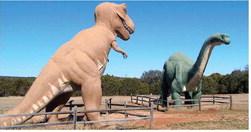
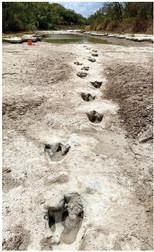
HOWEVER, again just recently, more DINOSAUR TRACKS have been found as a result of the drought and heat during our recent dry spell, and some are thought to be those of a creature—SAUROPOSEI-DON— that walked on all four legs, weighed up to 120,000 pounds, stretched out maybe 111 feet in length, and had a very long neck. Its footprints, perfectly preserved in the stone bottom of the dried-up riverbed, were as massive and wide apart as an elephant’s. And footprints of a 3-toed beast that most youngsters would identify as a Tyrannosaurus rex, roughly 15 feet in height, 14,000 pounds in weight, and full of fight and fury and teeth that tore, have also been identified! (Scientifically this one is named an Acrocanthosaurus.) The Paluxy River usually flows through this Valley/Park and keeps the river area covered with silt, sediment, debris, small rocks, and water, but the newly-dried portion of the river valley has exposed the very distinct and “study-able” tracks of two different species of dinosaurs.
And, this is the 2nd time this has happened during the past two years, showing footprints that were made in the soft silt (sediment) that over time hardened into limestone that is visible today.
So, researchers and scientific experts will be busy mapping, photographing, and making molds to display in study areas and in museums before the tracks fill up once again with what was stated above was exposed by the hot, dry weather. Once scientists have these copies of the approximately 75 new TRACKS that have been discovered due to the recentlydried river bed at Dinosaur Valley in the State Park in Glen Rose, Texas, more or less south and west of Dallas about 80 miles away, they will not be worried as the sediment and silt and water once again cover the tracks, which probably some day will erode away permanently!
Note—If you have never been to Glen Rose and the State Park, I recommend that you schedule a trip now, before the river rises. If you wait too long, rains will surely return, and the cold weather will also come!
- Log in or Subscribe to post comments.