
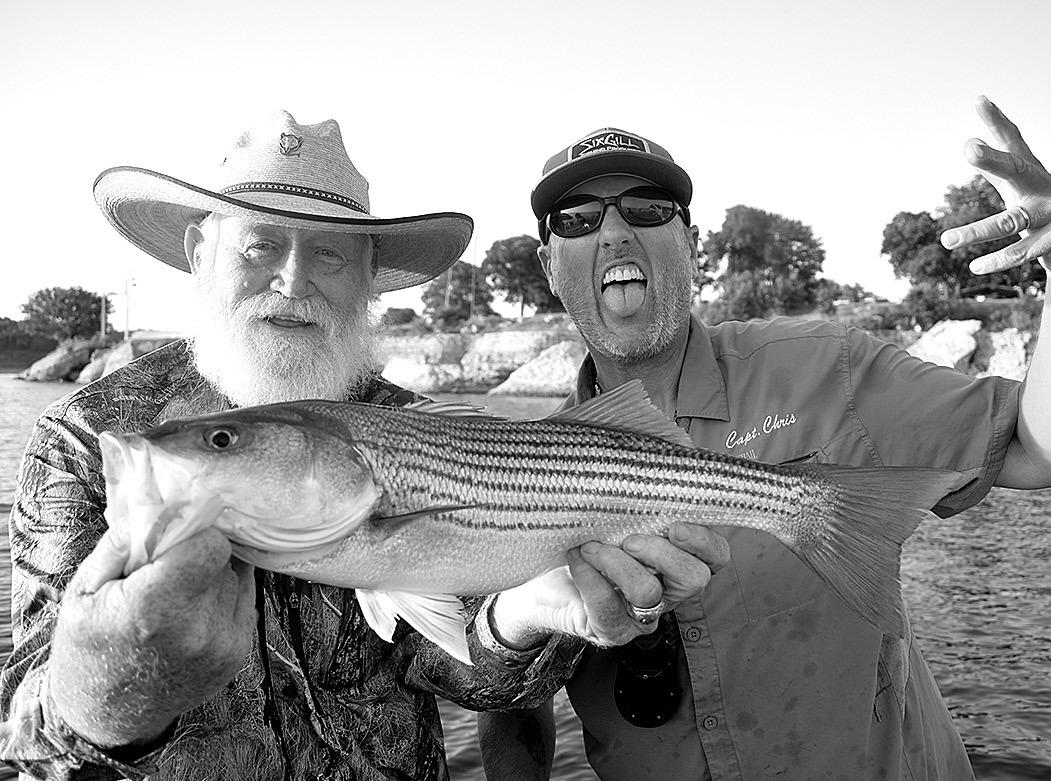
Just at the break of day one morning last week, Texoma guide Chris Carey with Striper Express eased his big guide boat up to the mouth of a little pocket in the lower lake. A point jutted out from shore and on the very end of this point, a great blue heron stood like a statue awaiting breakfast. The bird and our guide knew what was about to happen. First, we noted a few shad dimpling the water’s surface and then several top water explosions as stripers drove the shad schools to the surface and attempted to render them helpless with the slap of their broad tails. The heron took wing and headed to the beginning of what soon became a top water feeding frenzy. Dipping to the surface, he scooped up his breakfast of choice, a tasty shad. Chris coaxed maximum speed from the boat’s trolling motor. He knew firing up the big engine would get us there faster but would probably spook the feeding fish. We were soon within casting range of a good half acre of greedily feeding stripers and were heaving big Pencil Poppers into the midst of the frenzy.
The pattern is a yearly fishing event that I first enjoyed well over three decades ago when Chris’ father, Bill Carey, called and invited me up for a very dependable topwater bite. “Luke, the summer topwater/slab bite is on! Huge schools of stripers are pushing bait to the surface in the lower lake. The topwater bite is as good as it gets.”
“Come a-running” were the words Bill used! Much more recently, while visiting with Bill on the phone, he used the same phrase. Chris had an open morning, and my friends Jeff Rice and Larry Weishuhn and I drove up the evening before and spent the night in a comfortable cabin at Mill Creek Resort. The next morning it was a short walk to the dock and an exuberant Chris Carey. “Just enough chop on the water to make for a great early morning top water bite. How about starting the morning with one of these tacos?” After an early morning boat ride snacking on some tasty breakfast tacos, we were smack dab in the striper feeding frenzy just described!
Luckily, this dependable top water action occurs during the first few hours of daylight while temperatures are pleasant. By midmorning this time of the year, it’s best to be heading to dock with some wind in your face and, if you were fishing the pattern we just enjoyed, a cooler full of good eating stripers!
Stripers will hit a wide variety of top water plugs, but the big Pencil Poppers are hard to beat. The Choppo is another excellent bait. With a propeller that churns a lot of water, these baits have become very popular also. Presentation is pretty simple with the Pencil Poppers. Make long cast, and if the fish are blowing up on surface, cast just past the action and jerk the rod tip hard a couple of times to cause as much ‘ruckus’ as possible. The goal is to get the stripers’ attention. Even if you don’t see fish on the surface, be ready! Blind casting sometimes produces some of the biggest stripers of the trip. With the bait in the water, the basic ‘walk the dog’ retrieve will draw strikes. I like to occasionally let the bait pause a couple of seconds. This is when strikes often occur. I assume the striper thinks the motionless bait will be an easy meal and triggers the strike, but who really knows what a fish ‘thinks’! Getting the hook set is not always as easy as one would think. With the big treble hooks on the plug, it seems a hard-hitting striper would get hooked on its first strike, but this is not always the case. Stripers often use their broad tail in attempt to stun the baitfish, and very often the fish’s tail contacts the bait before its mouth. One’s first reaction when a fish explodes on a top water plug is to instantly jerk back on the rod. After all your mind is telling you the fish is trying to take your bait, and your reflexes are instructing you to take it back! The rule of thumb is to wait until you feel the pressure of the hooked fish on the rod before pulling back to ensure a good hook set. Believe me, this is easier said than done, even for experienced fishermen.
We enjoyed a couple hours of top water action and then switched to lead slabs. I’m not sure if color was all that important, but the fish were hitting our chartreuse baits, hard. As much as I love catching fish on the surface, I might enjoy slab fishing more. There is something about the instant ‘jolt’ of a striper hitting a fast-moving bait that gets my adrenaline pumping! When fishing with slabs, presentation is always key and if I’m fishing with a guide, I always ask them ‘how do they want it”? We were fishing water sixty to seventy feet deep, and the drill was to allow the baits to contact bottom then reel them up vertically as fast as possible. One would think fast cranking one of today’s fast retrieve reels would move the bait much too quickly but not so. Stripers are extremely speedy fish, and I honestly don’t think it’s possible to move a bait so fast that they can’t catch it. This day, they wanted the bait rocketing through the water, and they had no problem catching it. I caught my biggest fish of the day shortly after we switched to the slabs. The ten-pounder hit the bait like a freight train as I was cranking the reel as fast as I could. One moment the slab was zipping through the water column; the next it was slammed by the big striper which was swimming as fast as the bait was moving, actually just a little bit faster. The reel’s drag system instantly went to work, and the fight was on. So it went until about 10 o’clock. We had a nice box of stripers and were all happy to feel the breeze in our faces as we headed back to Mill Creek Resort.
This consistent pattern will remain for some time; shad schools are well dispersed and stripers are going on a daily feeding binge. As Mr. Carey says, “Come get you some”!
Contact Striper Express at www.striperexpress. com. Watch “A Sportsman’s Life” on Carbon TV to see the action. Email outdoors writer Luke Clayton through his website www.catfishradio.org.
- Log in or Subscribe to post comments.