
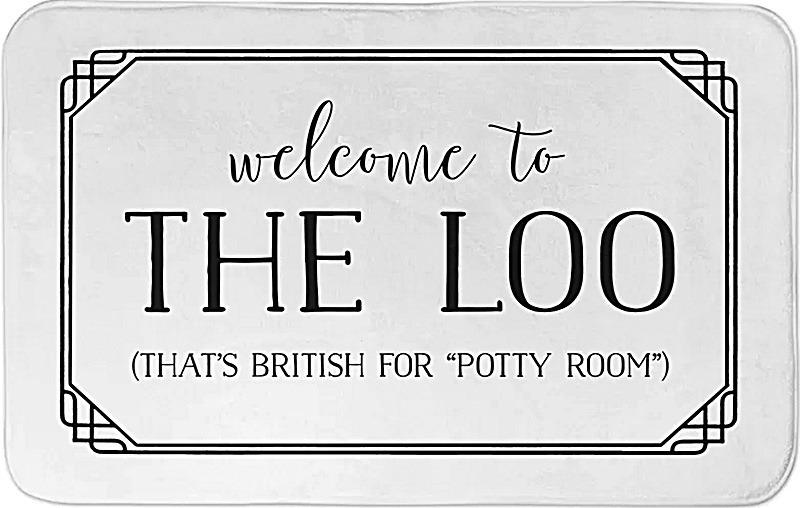

I went to the UK as a just turned seventeen-year-old young woman in 1984, the summer before my senior year in high school. It was a school sponsored trip; a hybrid culture meets teaching vacay with my World History teacher as the guide. We had many meetings on what to expect during this 21-day multi country journey. Great Britain was first on the list. “Don’t think it will be a breeze in England,” I recall Linda Massey telling us. “They are not easy to understand, even though English is their mother tongue.” Ewww. Tongues. My seventeen-year-old brain wasn’t all that sophisticated. We practiced, relentlessly, how to ask for a restroom in French, Italian, and German. Then, we addressed the UK. “They don’t say bathroom or restroom. In fact, if you ask for a restroom in England, they’ll direct you to a park bench…to rest. You’ll have to ask for the WC. That stands for water closet. That’s what the Brits call a bathroom.” Imagine my shock and horror when I asked a young woman with a beyond thick Leicester accent – this is pronounced Lester, by the way, leading me to believe these must be the people who named Worcestershire sauce – where the closest water closet was, only for her to say a lot of mish mash words at the speed of light that included something called a loo. Me to my friend Tonya, “What’s a loo?” Tonya’s response did not aid in my discovery. “Like, skip to my Lou my darlin?” I did not think that was the case. Loo is, as we probably all know now, thanks to The Crown, short for lavatory. That makes as much sense as finding out Dick is short for Richard. I think about that moment often. They don’t say their Fs, these Leicester folks. And, their words pop out so fast, all staccatoed with rounded Os and lots of Oys. But, loo, lavatory, WC, water closet, bathroom, restroom… where did we get all these room names? Down the rabbit hole we go. And, we’re going fast. We only have 600 more words at our disposal. Insert wink face emoji.
If you’re a real estate agent, please know I am not trying to get your hackles up. But, you can’t deny the anger and rage over the term Master Bedroom. In fact, my research shows MLS has tried to eradicate the term completely, preferring Primary Suite or Owner’s Retreat. I did some digging. The term was first used in 1926, by Sears and Roebuck, no less. Once upon a time, you could order a house from the Sears catalogue. They would ship the plans, the lumber, the nails, the whole shebang, right to your closest post office. It was literally a home kit, a master planned home with a master planned bedroom. This was soon shortened to master bedroom. Sears was trying to harken back to the days of castle origin, where footmen served masters and lords and such. But, you can’t go far in this world without creating baggage. This one is bursting at the seams, because, yes, slavery did include servitude to men addressed as master. So, be gone with your silly master term. Besides, there is only one master of this house. He is a fluffy white poodle named Finnegan. Insert eye roll emoji.
Next on our hit list is the parlor. We don’t really say parlor anymore. I’m trying to bring it back like a mean girl who wants to make fetch happen. Can I get a round of applause for the Regina George reference? Nowadays we call parlors formal living rooms. But, the term parlor hails from the French word parlëure, meaning “to speak.” Parlors were fancy. They meant that you were wealthy enough to separate your genders after supper. The men would all go to the study to talk about politics, light their pipes, and drink their spirits whilst the womenfolk would convene in the parlor where they would perch daintily on Louis XVI sofas to sip tea, wary of bending at the waist while sporting corsets. Parlors meant you were a somebody. Heaven forbid if you dined with a nobody.
Finally, I think I was most shocked and simultaneously most attracted to the his-tory of the living room. We skipped kitchen because it literally translates to cook room in case you were waiting on that one. In the US, until recently – meaning turn of the 20th century – homes had death rooms. This was because funeral homes didn’t exist. When a loved one passed away, their bodies were brought to their respective homes where friends, family, and general townspeople would drop in to view the body for up to a week after they perished. If the family knew in advanced that someone was likely dying soon, perhaps a table would be built for that purpose. If the death was sudden, or happened in multiples as in a smallpox epidemic, all bets were off. Doors were propped on sawhorses and draped with fabrics. Dining room tables were another popular option. In fact, the term death room was still being used a decade after funeral homes became available as a more socially accepted option. Ladies Home Journal ran an article, in 1910, petitioning the public to please begin using the term living room instead. Why did this knowledge mesmerize me? I recall buying our 1910 home from a local historian. I gasped at the front door, “Wow, that is a massive front door.” The gentleman winked at me, “Yes, doors had to be at least 3 feet wide so a casket could be both brought in to retrieve the deceased and taken out for burial.” Words are amazing. They ebb and flow and morph and have power and lose power and confuse us and inform us, all at the same time. Enjoy your word salad today.
- Log in or Subscribe to post comments.