
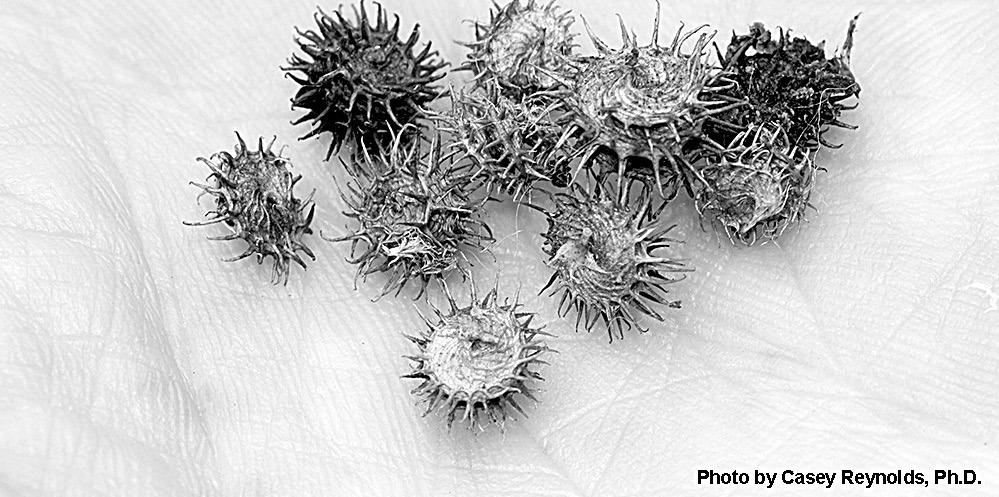
Well last year this pesky lawn weed was my number one horticulture related call for two months. This weed that has infected a vast majority of yards in our area. Lawn burrweed, car‑pet burrweed or spur weed (Soliva spp.), a cool season annual introduced from South America, has become a nuisance on golf courses, athletic fields, parks and lawns throughout much of Texas and the Southwest. The weed becomes a real nuisance when the seed ma‑tures in the spring because the sharply pointed spines on the seed can easily pierce the skin. Burweed becomes a deterrent to the use of athletic fields, parks and playgrounds in the spring when the seed mature. On golf courses, burweed in‑vades even the most closely mowed putting greens as well as fairways, tees and roughs.
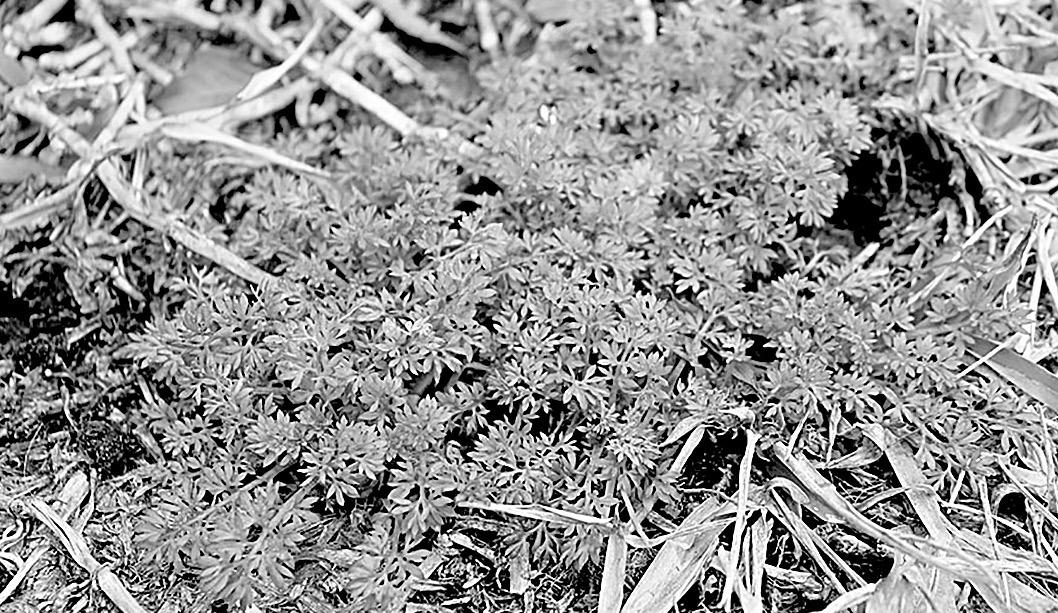
Description. Burweed is a small, low‑growing annual plant. In an un-mowed site, it only reaches 2 inches in height and the individual plants may spread out to about 6 inches in diameter. Leaves are pinnately divided giving the plant a feathery appearance. The seed enclo‑sures are flattened, callous structures terminating in teeth on spines.
Burweed emerges in early fall and matures in the spring. The vegetative part of the plant dries up in May and the seeds remain to ger‑minate the next fall. Popu‑lations of the weed may become so high that plants cover the ground like a car‑pet‑thus, the name “carpet burweed.” Where grassy weeds such as annual blue‑grass are eliminated using preemergent herbicides, populations of burweed in‑crease dramatically in fol‑lowing years.
The key factor to effec‑tively controlling lawn bur‑weed is to apply a post-emer‑gence herbicide during the winter months of December, January and February. The weed is smaller and easier to control during this time of year and has not yet devel‑oped the spine-tipped burs. Control is not impossible in March, April, and May, but the spines have already formed by this time and will remain after the weed dies. Because lawn burweed is a winter annual, it will begin to die in late spring as air temperatures reach 90 °F. Once the weed has reached a more mature state, mul‑tiple herbicide applications may be necessary which increases the potential for turfgrass injury. Dead or alive, lawn burweed poses a painful problem. The only solution to this is early iden‑tification and control.
A three-way herbicide may be used on bermu‑dagrass and St. Augustine grass. The active ingredi‑ents of a three-way herbi‑cide often include the follow‑ing broadleaf weed killers: 2,4-D, dicamba and me‑coprop (MCPP). Examples of a three-way herbicide are Ferti-lome Weed-Out Lawn Weed Killer with Trimec, Bayer Advanced South‑ern Weed Killer for Lawns, Spectracide Weed Stop Weed Killer for Lawns, and Southern Ag Lawn Weed Killer with Trimec Control.
Like most broadleaf weeds, burweed is easily controlled in the seedling stage with hormone‑type herbicides. Products containing a mix‑ture of 2,4‑D, MCPP and dicamba will control bur‑weed in the seedling stage. No one chemical alone can kill this weed. Also, realize treating this time of the year, you may kill the plant itself, but the burr has already been produced, thus a seed that can emerge next year. So, for 2023, spray earlier.
Isoxaben is a pre-emer‑gence herbicide for control of lawn burweed, as well as many winter broadleaf weeds in bermudagrass and St. Augustine grass. Apply isoxaben in late September to early October before the winter weeds germinate. Do not reseed or overseed with‑in 60 days of application, and do not apply to newly seed‑ed lawns until the lawn has been mowed three times. An example of a home lawn granular product contain‑ing isoxaben is Green Light Portrait Broadleaf Weed Preventer. Granular preemergence herbicides must be activated by ½ inch of rainfall or irrigation. Some other preemergent herbi‑cides are generally not ef‑fective for burweed control. In fact, burweed populations increase where preemer‑gent herbicides reduce the competition.
For more information on lawn burweed or other turf weeds, please contact the Kaufman County Extension office at (469) 376-4520.
- Log in or Subscribe to post comments.