
Texas Republicans helped elect U.S. Rep. Kevin McCarthy, R-Calif., as House speaker in the early hours of the morning Saturday after four days of bitter infighting within their party that kept Congress at a historic standstill.
Texans played a central role in the intraparty dispute, with three Texas Republicans voting 11 times against McCarthy’s bid for speaker, expressing discontent with how party leaders have run the House Republican conference. U.S. Rep. Chip Roy, RAustin, emerged as a lead dissenter, issuing impassioned pleas for a complete shakeup of House rules that he said would keep leadership more accountable. U.S. Rep. Michael Cloud, R-Victoria, and U.S. Rep.-elect Keith Self, R-McKinney, had similar concerns and voted in line with Roy and a group that started at about 20 anti-Mc-Carthy Republicans.
By Friday afternoon, they had reached an agreement with party leaders and voted for McCarthy in exchange for continued talks on how to reform the chamber. Roy was one of the top negotiators with McCarthy and his allies, and a wave of Republican objectors joined him when he switched his vote. By Friday afternoon, 15 members switched their votes to support McCarthy.
It wasn’t until a 15th speaker vote that enough members voted to give Mc-Carthy a majority in the chamber and deliver him the gavel.
The chamber reconvened at 10 p.m. Eastern time Friday night to start what many Republicans were optimistic would be the final vote of the night. Members brought their families into the chamber and were ebullient as they cast their votes.
But a couple of surprise continued votes against Mc-Carthy and two votes present gave McCarthy only 216 votes — one shy of victory.
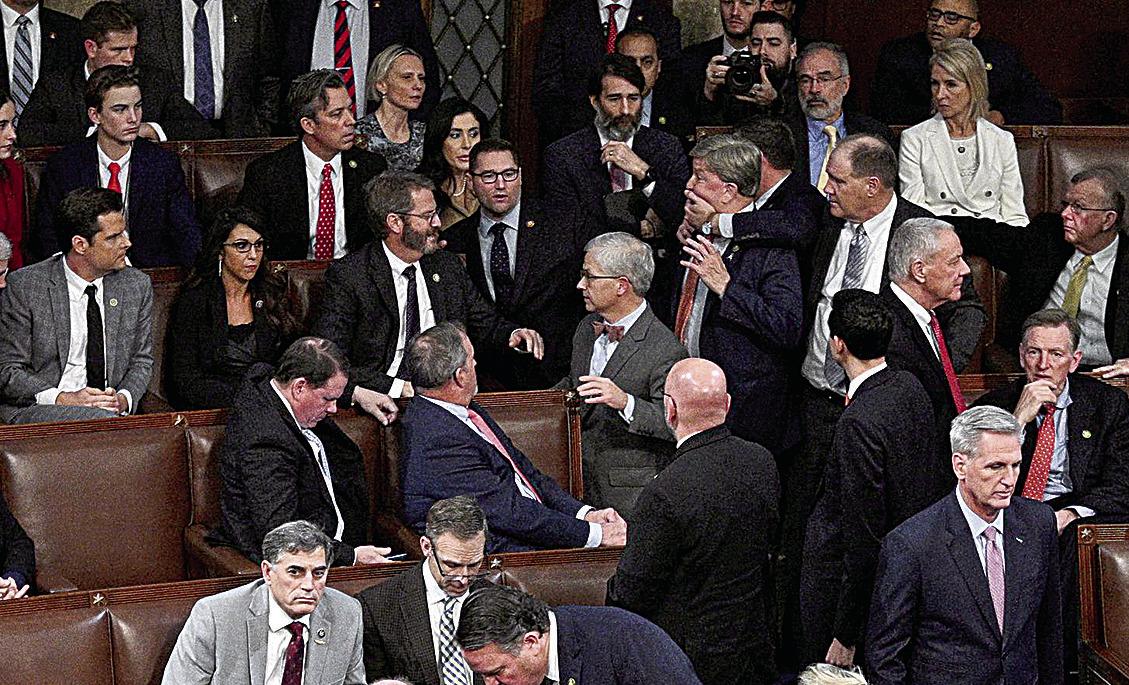
The chamber floor became tense, with party leaders crowding around Reps. Lauren Boebert, R-Colo., and Matt Gaetz, R-Fla., who both voted present. At one point, Rep. Mike Rogers, R-Ala., leapt toward Gaetz and had to be physically restrained before storming off the floor.
But Republican leaders were determined to win and refused to adjourn for the weekend. In a second vote that stretched past midnight and into Saturday morning, McCarthy won with 216 out of 428 votes.
The win was so narrow that U.S. Rep.-elect Wesley Hunt, R-Houston, who had gone home to Texas on Friday morning had to fly back to the Hill on Friday afternoon to ensure Mc-Carthy had enough votes. Hunt tweeted that he had gone home to take care of his wife who had a medical complication after she gave birth to their premature newborn earlier this week.
The members initially opposed McCarthy in a bid to implement a number of priorities outlined by the deeply conservative House Freedom Caucus. Those measures include allowing a vote to unseat the speaker to initiate with a single member, committing to a vote on legislation balancing the federal budget, more time for members to read legislation and a greater role for Freedom Caucus members in party decisions.
“Few people are making too many decisions for the American people in ways that undermine the health and well-being of this institution, the country and American people,” Roy told reporters. “That has a chance to change today, and that’s why we’re here.”
McCarthy is the first speaker election in over a century that required multiple votes. For the first four days, members gathered in the chamber for a monotonous series of roll call votes, often with restless jeering and heckling at each other for keeping each other from starting the House’s business. Without a speaker, members could not be sworn in, consider bills, form committees, help constituents or access sensitive information.
The Senate was in a longplanned recess through most of the debacle, but members of the upper chamber mused that if the stalemate continued when they return on Jan. 23, they would have to divert all of their attention to confirming appointees. Democrats uniformly voted each time for their leader, Hakeem Jeffries of New York, to be speaker, mocking Republicans for not being able to rally around one leader. But McCarthy also had a powerful operation himself to get members on board, with several deputies extolling their peers to vote for him. Gaggles of Texas Republicans loyal to McCarthy met with their dissenting fellow Texans to get them on board on the sidelines of the votes.
U.S. Rep. Dan Crenshaw, R-Houston, was a vocal critic of the 20 so-called Mc-Carthy rebels, referring to them as “terrorists” at one point and frequently accusing them of self-interest.
House Freedom Caucus member U.S. Rep. Troy Nehls, R-Richmond, took to the House floor Thursday to nominate McCarthy, saying he would be the best person to implement the Freedom Caucus’ deeply conservative agenda.
“Kevin is aware that any legislation he would like to pass out of this House would require support and endorsement from the Freedom Caucus,” Nehls said on the floor. “This is where I believe we can hold the speaker accountable.”
In the end, all but six Republicans voted to make McCarthy speaker.
“This is what a government for the people looks like. It’s deliberative. It’s people talking through issues,” Cloud told reporters after changing his vote for McCarthy on Thursday. “It’s figuring out how to get through problems and how to make this place work for the American people.”
But the end of the election does not mean the end of the right-wing members’ fight. Roy, Cloud and Self all said they would continue talks to fully implement their priorities and ensure leadership does not stray too far from their promises.
“Our message to Speaker- elect McCarthy is that that framework serves as the template by which we’re going to be holding him accountable,” Roy told reporters.
Long before the speak-er’s race, McCarthy had been expressing viewpoints to win over the support of the party’s right flank. He signed on to Roy’s promise to block any priorities by Senate Republicans who voted for a bipartisan $1.7 trillion appropriations bill late last year. Senate Republican leadership backed the bill, meaning McCarthy and Roy’s position could tee up major intraparty feuds between the two chambers for the next two years. He also gave an eight-hour speech in November 2021 to delay passage of Democrats’ cornerstone infrastructure, climate and health care bill.
But that wasn’t enough to win over the entire party. House Republicans gathered in November to select their party’s nominee for speaker. Roy nominated U.S. Rep. Andy Biggs, RAriz., as an alternative, and Cloud seconded his nomination. Though an overwhelming majority of House Republicans voted for McCarthy, the meeting set up the small but loud resistance camp that held up the chamber wide speaker vote this week.
Cloud, Roy and Self have all said they did not have a personal animosity toward McCarthy, nor did they have any particular affinities to alternative candidates. Throughout the marathon votes, the three swapped votes for U.S. Reps. Byron Donalds, R-Fla., and Jim Jordan, ROhio, to cast their dissent against McCarthy. Roy and Cloud were seen jetting Thursday between the House floor and Republican Whip Tom Emmer’s office, where they spent hours working out a path forward with McCarthy’s allies.
- Log in or Subscribe to post comments.