
When hunting, nothing takes the place of good old fashioned woodsmanship which is learned only by spending time in the woods and fields observing animals and the signs they leave. Back when I was a youngster, the only way to learn about wildlife was to look for the signs the animals made or actually observe them while hunting or scouting. Then, maybe four decades ago, the idea of capturing the image of big game via a remote camera appeared on the hunting scene. I remember a company shipping me an old 35mm film camera encased in a somewhat waterproof box that was stateof- the-art technology, at least at the time. The camera had a thin trip wire that was stretched across a game trail. When the animal touched the wire, the shutter fell on the camera and, supposedly, the image was captured on film. Of course, the film than had to be developed in order to see the image. As I remember, my success with this crude ‘trail camera’ was less than stellar.
And then when technology advanced to digital and trail cameras began using SD cards to capture and store the image, I was quick to jump on board with one of the earlier models. Now, I could have my camera out in the field, capturing images around a feeder or well-used trail and occasionally go and pull the SD card, plug it into my computer and see the photos as well as the time and date the animal passed through. “Cutting edge,” I thought. And it was at the time, but little did I know how fast this technology would progress.
A few years ago, a buddy told me about his ‘remote’ camera that captures images and sends them to a website which he could access and see the activity around his deer feeder. I remember telling him this was almost cheating! The service was not cheap, but it did give my friend instant access to the goings on at his deer lease. A few years later, smart phone apps were developed that allowed the images to be instantly transferred from the remote ‘live’ cameras to the phone. This technology is very popular today; I have a couple of these still cameras on my cell phone app where I watch wildlife on a daily basis.
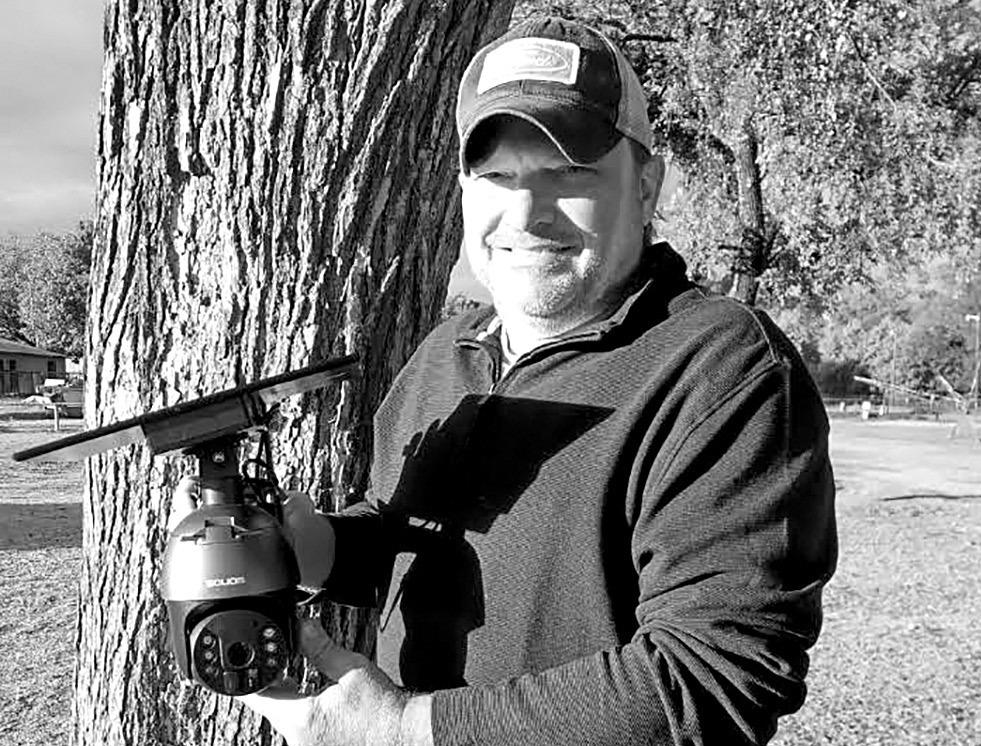
These advancements have revolutionized the way many of us keep tabs on the wildlife on our property or leases but, as the TV pitch men say… wait, wait; there’s more! I recently spent some time with Steven Waugh who is an expert in video camera surveillance both for homes and businesses and in the woods. Many of you will remember a column I did with Steven a few weeks ago. He is the licensed wild hog buyer from Kaufman County that actually comes to your property, picks up the hogs you caught and pays you for them. Technology is helping Waugh greatly by saving gas running to check traps. He introduced me to his video surveillance cameras that are solar powered and virtually maintenance free once they are mounted on your food plot or near a game feeder.
“Many of my customers are amazed to learn that for about $200 I can set them up with a video camera that sends live video to their smart phone in 4G LTE resolution. The app allows the user to toggle right and left and cover about 320 degrees in front of the camera. With a zoom button, it’s possible to zoom up close to get a really close look at a buck’s antlers.”
I can see how helpful it would be to determine trails deer are using to approach a field or feeding area. With the remote still cameras I use, it’s pretty common to get a glimpse of a buck and have him walk out of the viewfinder. A video camera that can be maneuvered to actually ‘track’ a moving animal is a huge benefit. While most still image cameras transmit photos in about 2 minutes, Waugh’s camera’s video feed hits your smart phone about 30 seconds past real time.
Waugh says it is important to set the camera up on a small sapling or metal post, as trees of large diameter will limit the amount of area the camera can record. One of the biggest features with Waugh’s video camera is the SD card that automatically switches to ATT or Verizon, depending upon which has the strongest signal in a given area. Cost of the service is $15 per month. When one stops and thinks about it, it’s doesn’t take long to spend fifteen dollars in gas when driving to the lease to pull and check the SD cards in conventional trail cameras. With the live real time video, it’s possible to monitor an entire food plot or field and determine the best spot to set up to hunt. Incorporate a bit of hunting savvy such as wind direction and pattern of game movement into and out of the hunting area and the hunter really can do a great deal of ‘scouting’ from his or her easy chair at home or the break room at work! Cell coverage by at least one of the carriers has proven good in most locations where Waugh has his cameras running, but he also offers an antenna that plugs into the camera that increases the signal if necessary.
Yep, scouting for game has come a long, long way since I was a boy back in Red River County learning the difference between hog and deer tracks or determining if the bits of acorn under an oak were left from a feeding deer or squirrel. If someone had told be back in those days that I could look at a little device I held in my hand and watch a spot deep in the woods where I hoped to see deer, I would have thought them from another planet! We hunters have come a long, long way utilizing modern day technology. But regardless how far these eyes in the woods have taken us, woodsmanship is still very important. After all, we need to know ‘where’ to set cameras in order to monitor game and this kind of knowledge comes from time spent in the woods! Learning how to pattern the game animals we hunt is a big part of what makes hunting challenging and fun. But I must admit, I have become very dependent upon the pictures these cameras send me from remote areas.
For more information on the use of video surveillance cameras for hunting, contact Steven Waugh at 214- 8095303 or email executive. tech43@gmail.com.
- Log in or Subscribe to post comments.