
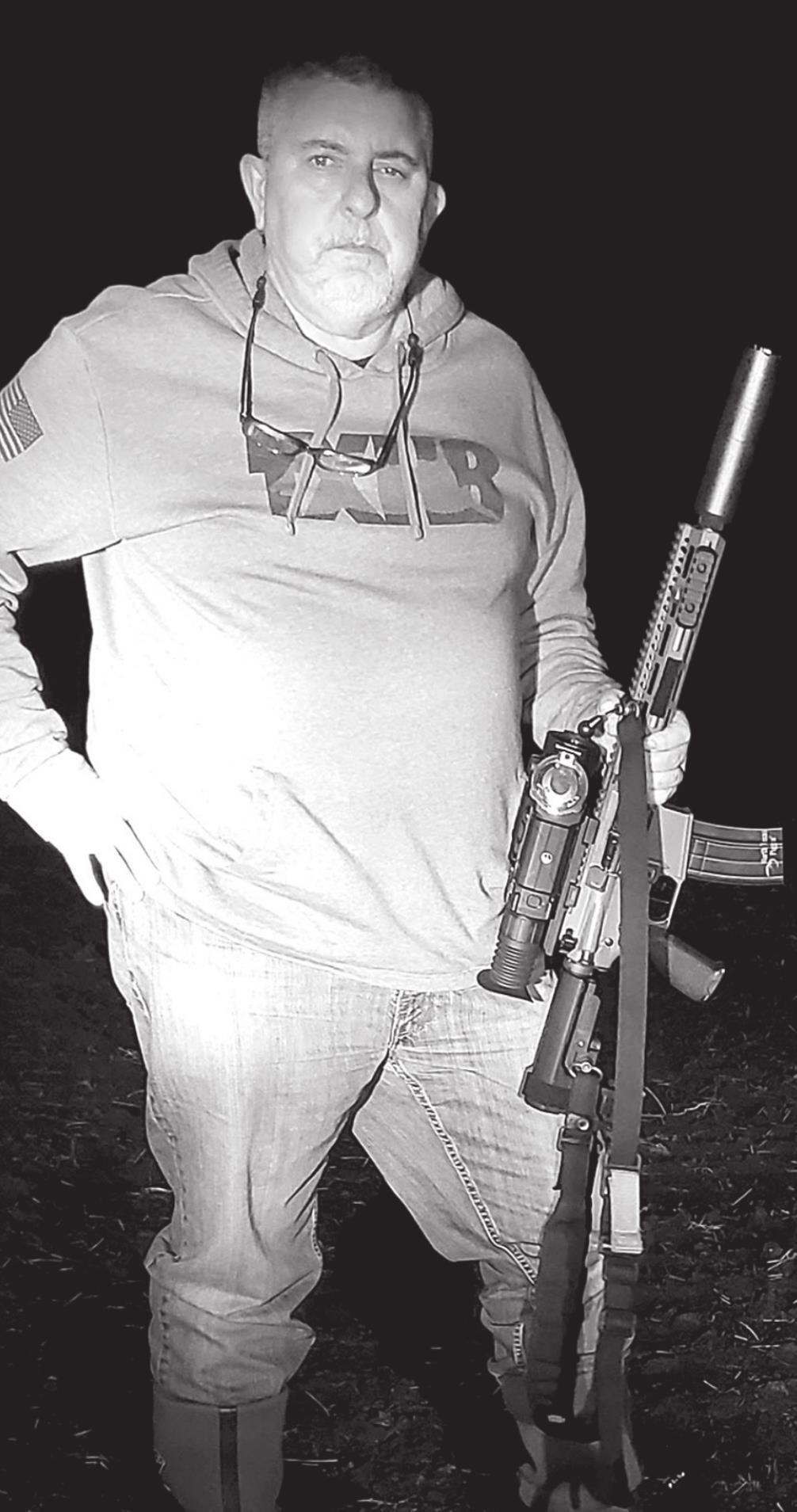
I love hunting wild hogs as I’m sure most readers of my column have learned through the past several decades. I even wrote a book on the subject a few years ago. There is something very exciting about sitting over a corn feeder, whether during the day or at night, and first hearing a sounder of hogs coming through the woods and then having them appear.
Wild hogs are smart; I think they have the ability to reason or at least react to conditions and adjust their patterns to fit circumstances. When pressured, they often become almost entirely nocturnal. Through the years, I’ve hunted hogs almost as much at night as during the daylight. I remember back in the eighties when wild hog were just becoming plentiful, a buddy and I hooked a couple of car batteries in series and powered a string of DC light bulbs back in the woods. We baited the area for several days and then hunted the spot. When we heard the hogs crunching the corn, we flipped the switch and ‘lit them up’. In the ensuing years, I’ve used everything from red and green lights to digital night vision for night hunting.
For the past several years, I’ve used a digital night scope on my rifle and made precise, close in shots on hogs, always inside 75 yards and usually at around 50 yards. These digital day or night scopes are made by several manufacturers and they work just fine when shots are kept at a reasonable distance. And because they work on IR (Infrared light), there must be a clear line of sight from the shooter to the target. Leaves or other obstructions create refraction and obscures the target. I’ve killed lots of hogs, usually around a corn feeder or out in an open field using my digital scopes but found them next to useless when hunting in heavy cover.
Thermal imaging scopes are, hands down, the best tools for hunting hog at night but until recently they came with a hefty price tag, thus the reason I and many others used digital scopes the past several years. Thermal scopes show the heat signature of hogs or any animal or object at night that has a contrasting temperature to its surroundings. With a thermal scope, it’s easy to see hogs or any other animals moving through heavy brush and there is no refraction from leaves or brush to obscure one’s view of the target.
I’ve known the advantages of using thermal for night hunting for several years but because of price (digital scopes cost around $500 opposed to several thousand for thermals), I continued using my digital scope. But now a company, AGM Global Vision, has a line of thermal scopes called The Rattler on the market that is both affordable and of high quality. The price tag for the entry level Rattler is about twice the cost of most digital scopes which puts thermal hunting in the price range of a great many hunters.
This past week, Paul Tyson, owner of www.gearthehunt.com and North Texas Piggin, a Facebook group, came out to the house with a couple of the Rattler thermal scopes, one for my friend Jeff Rice and the other for myself. Paul is a storehouse of knowledge on thermal scopes and thermal hunting and I found the learning curve switching to thermal to be easy, thanks to some expert advice. I’m definitely not the most technical person and having someone like Paul to answer questions made my move to thermal much easier. I was actually out in the woods close to the house hunting hogs the same evening we mounted the scope on my rifle. The wild porkers decided to move later in the evening than I was willing to hunt. I used the onboard video and still camera on the scope to film a variety of critters including one big rat that scurried around the feeder eating corn, an owl that perched in a nearby tree and several raccoons.
In the scope’s white hot mode, it was easy to positively identify all the critters. It was amazing to have the ability to look back into the brush and see animals that I would have never known were there. There is no telling how many wild porkers I have missed seeing in past years. Just like deer, wild hogs sometime approach a feeder in stealth mode. With my Rattler, I’ll now be able to look back into the woods and when I hear that stick break, an animal pulling it’s foot out of the mud or the sharp squeal of a hog I can make a positive identification and have the rifle ready to make the shot.
Several of my friends that have been hunting with thermal scopes for years have told me about the things they see in the night woods, such as an owl swooping down on a rabbit or rat or a bobcat stalking its prey. I’m not sure just how well an owl can see at night but I’m pretty sure the view through a thermal scope must surpass the vision of a night hunting owl and an owl has excellent night vision. I watched one the other night with my thermal scope flying through the branches of a nearby oak and it never came close to a limb. A few years ago, I went rabbit hunting with a good friend that has many years experience using thermal imaging. He would use his thermal spotter to locate rabbits and we would stalk within shooting range and then use a conventional green or red light. I remember looking through his spotter and the rabbits stood out in stark contrast to their surroundings. The use of thermal scopes is a definite game changer for those of us that hunt hogs at night, a far cry from the old car batteries and light bulbs I used forty years ago!
Remember the Outdoor Ren De Voux in Greenville on March 12 at the Top Rail Cowboy Church. For booth space, contact pastor Charlie Nassar at 903-217-3778 or Luke at lukeclayton1950@ gmail.com. Come enjoy a day of fun and celebrate the outdoors with Luke and a host of his good friends.
- Log in or Subscribe to post comments.