
One thing I’ve learned through the years about catching fish: There is usually a pattern and bait that will produce action, regardless the lake, time of year or species. Finding that pattern is the challenge!
For many years, I have enjoyed catching white bass, sandbass as they are referred to in North Texas. I enjoy fishing for them throughout the year but when the water gets really cold in the dead of winter, they can be a bit tough to consistently catch. I have a guide buddy now retired that showed me a technique on Richland Chambers years ago that often produced cold water white bass.
He used to tell me, “Luke, drop that lead slab down to bottom and try to stand it on end, right on bottom and then lay it down flat. This is the only pattern that is working for me when the water temperature gets down in the forties.” Of course, the slab wasn’t sitting motionless on the lake bottom because of boat movement, current, etc. There had to be a bit of movement of the bait and that slight movement was often just enough to entice a bite from a lethargic white bass.
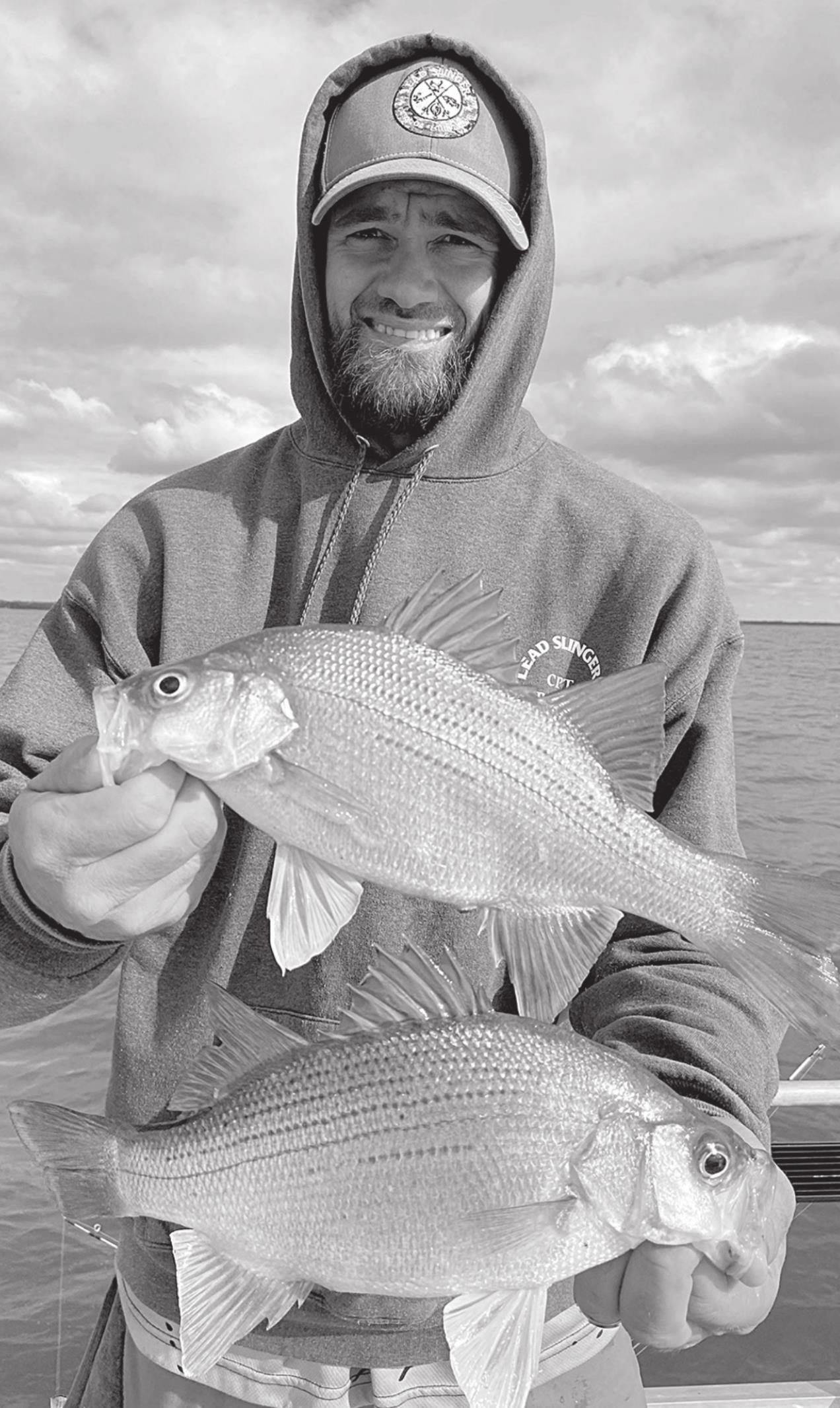
Just this past week, I joined guide Brandon Sargent, owner of Lead Slingers Guide Service on Lake Ray Hubbard, and learned more about catching white bass in cold water in three hours fishing than in the past four decades. Sargent is a savvy angler, regardless whether he is targeting white bass, crappie or hybrid stripers and when he called last week with an invitation to fish, I was excited about getting on the water and more than ready for a platter of crispy fried white bass fillets!
Sargent, like many guides today, used a Garmin Livescope to not only help him find fish but to also make precise bait presentations. I knew the Livescope was highly effective in catching crappie holding on structure but I had never used it for schooling fish such as white bass that are constantly on the move chasing baitfish.
We were fishing deep flats in the lower lake in water 38 to 40 feet deep. The drill went something like this: Sargent would engage the spot lock on the trolling motor which keeps the boat in place without anchor or tying up. He would then turn on the ‘Bobo’s Thumper’ which is a unit that runs on battery power and causes a rubber mallet to raise and lower, striking a plate and sending the rhythmic sound waves down below the boat to the fish. Very often the sonar showed a blank for ten or so minutes when we fist stopped and then the fish began showing up under the boat. Exactly why this ‘thumping’ sound attracts fish, I can’t say but it is a fact that it does, especially this time of year when the water is cold. You will see few striper guides on lakes such as Texoma that don’t have a ‘thumper’ of some sort on their boat this time of year.
When pods of white bass began showing up, we would drop half ounce chartreuse or white slabs down into the midst of the school. We kept a close eye on the bait on the Livescope’s screen and fish would be all around it but they would not bite. The only bait presentation that worked, and it worked just about every time, was to slowly raise the slab above the fish. Watching the screen, we would see two or three white bass following the bait up and invariably one would nail it. Leave the bait in the middle of the school and nary a strike, but crank the bait vertically through the water column out of the school and fish on!
By the end of February or early March the annual white bass spawn is usually underway on creeks and rivers above reservoirs with good white bass populations. Hotspots are traditionally the Sabine River above Tawakoni and below Toledo Bend and the Trinity River above Lake Livingston. Of course, spawning white bass also make their spawning run in many feeder creeks as well. For the past several years, I have eagerly awaited fishing with my friends on a feeder creek on the upper end of Lake Fork. I’m guessing there won’t be a ‘run’ on Fork this year because of low water levels when the lake was pulled down for repairs on the dam. Drought or near drought conditions prevailed through much of the winter causing many of the lakes to be low and very little water in feeder creeks. A few days of heavy rainfall could fill the creeks creating current and cause the white bass to move out of the lakes but without some heavy rainfall within the next month or so, I doubt if there will be a traditional ‘spawning run’. One thing is for sure, there is definitely not a shortage of big feisty white bass in Lake Ray Hubbard and, spawning run or not, the fishing should remain very good throughout late winter and spring. My biologist buddies tell me the whites will spawn in the main lake if there is no current to attract them to the rivers and creeks. They deposit and fertilize their eggs around windblown points with current. Contact guide Brandon Sargent at 469-989-1010.
- Log in or Subscribe to post comments.