

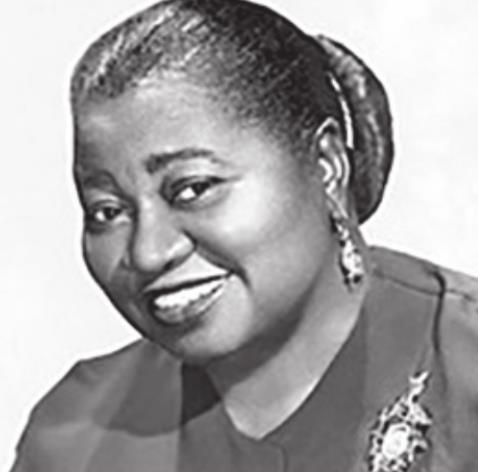
“This is one of the happiest moments of my life, and I want to thank each one of you who had a part in selecting me for one of their awards, for your kindness. It has made me feel very, very humble; and I shall always hold it as a beacon for anything that I may be able to do in the future. I sincerely hope I shall always be a credit to my race and to the motion picture industry. My heart is too full to tell you just how I feel, and may I say thank you and God bless you.” Fifty years before Whoopi Goldberg won a Best Supporting Actress Oscar for Ghost, and sixty-two years before Halle Berry would be awarded a leading actress Oscar for Monster’s Ball, there was Hattie McDaniel, who was deemed the best supporting actress for a little movie called Gone with the Wind. While no one can dull the sparkle of Hattie’s moment, her path to the big award, and the road that led away from that podium, was lined with turmoil. Though Hattie handled it all like the class act she was, it turns out that breaking through racially enforced glass ceilings is not for the faint of heart.
Susan Holbert and Henry McDaniel were born as Kansas slaves. Not much is available about Susan’s experience as an enslaved woman, other than she had a beautiful singing voice and favored gospel music. Henry fought in the Civil War for the Union. The 122nd United States Colored Troops was a division of the US Army. USCT soldiers died at a 35% higher rate than that of white Union troops. Post war, Henry & Susan settled in Wichita. By 1893, when Hattie was born, the McDaniels had 12 other children. When Hattie was 7, they moved to Ft. Collins, Colorado, then on to Denver. The McDaniel kids were orator extraordinaires. Sister Etta was an acclaimed actress, notably in the 1933 production of King Kong and over 59 other films, though many roles were uncredited. Etta and Hattie even had an all-female minstrel show in 1914. Older brother Sam appeared in over 210 television shows and films, most known for his portrayal of a butler in the Three Stooges film Heavenly Daze in 1948. But, Hattie was the complete package: singer, songwriter, actress, and comedian. In the mid 20s, she took the radio world by storm, appearing with the singing group the Melody Hounds on station KOA in Denver. By 1929, Hattie had recorded songs for Paramount Records and Okeh Records in Chicago, noted studio favored by Texas’ own Blind Lemon Jefferson. Sadly, the stock market crash of 1927 stunted Hattie’s recording career and she resorted to work as a restroom attendant at Club Madrid in Milwaukee. One night, when the talent did not show up for that evening’s performance, Hattie took it upon herself to command the microphone. Just like that, the bug had bitten again. She would eventually join her siblings in Los Angeles where she worked as a maid in between radio appearances. Hattie’s art eerily imitated her life. She would work as a maid. She would land an occasional radio or film role, as a maid. Then, she would work again, as a maid. Hattie played film maid to the likes of Mae West, Shirley Temple, Jean Harlow, Bela Lugosi, Katharine Hepburn, and Ginger Rogers, to name a very few. When she wasn’t playing the maid, she was playing a character like the one in Carol Lombard’s Nothing Sacred – wife of a shoeshine man. Even relegated to servant roles, Hattie managed to anger both sides of her coin. Black peers in Hollywood were livid at her acceptance of these stereotypical roles. White actors and audiences were livid at her comedic talents. She was deemed too uppity for her ability to sass back at Katharine Hepburn in Alice Adams, angering white moviegoers. In fact, Hattie doubted she was being seriously considered for the Gone with the Wind role at all, due to her agency’s representation of her as a comedian and not an actress. Besides, everyone knew that First Lady Eleanor Roosevelt had personally written to David O. Selznick, demanding that her own White House maid, Elizabeth McDuffie, be given the role. Some sources claim Clark Gable himself, having acted in at least one other movie with Hattie, recommended she be given the role of Mammy, house servant in charge of the film’s heroine, Scarlett O’Hara. Still, Hattie showed up for her audition in her own genuine maid’s uniform. And, win the role, she did.
Hattie McDaniel did not attend the premier of her flagship performance in Gone with the Wind at the debut at Loew’s Grand Theater on Peachtree Street in Atlanta. She couldn’t. Jim Crow law mandated that none of the black actors or tradespeople from the film could enter the theater. When it became clear that the film could sweep the Academy Awards in 1940, the problem intensified. Both the Ambassador Hotel in LA and its Coconut Grove restaurant, where the ceremony would be held, were segregated, with a very strict “no blacks allowed” policy. After much debate, a compromise was reached. Hattie and her escort could attend, but only if she agreed to sit at a segregated table set for two people in the far corner of the room. Her white agent, William Meiklejohn, caused a stir when he abandoned his assigned seat toward the podium and pulled up a third chair next to Hattie. No one thought Hattie would win. But, she did. Columnist Louella Parsons reported that Hattie, dressed to a queen’s taste with gardenias in her hair, gave a speech that put a choke in every throat. Later in the evening, as the film was being celebrated at the Oscar after party at a local LA club, Hattie was denied entry.
Hattie would continue her portrayal of a feisty and outspoken maid throughout the 40s, in such movies as Time, with Humphrey Bogart, and Disney’s Song of the South. In 1949, she became the first black actor to star in her own radio show with the comedy, Beulah. She was tapped to continue in this starring role as Beulah transitioned from radio to television, but her failing health prevented her from doing so. Hattie died of breast cancer in 1952. She was 59 years old. She wrote in her will, “I desire a white casket and a white shroud; white gardenias in my hair and in my hands, together with a white gardenia blanket and a pillow of red roses. I wish to be buried in the Hollywood Cemetery.”
- Log in or Subscribe to post comments.