

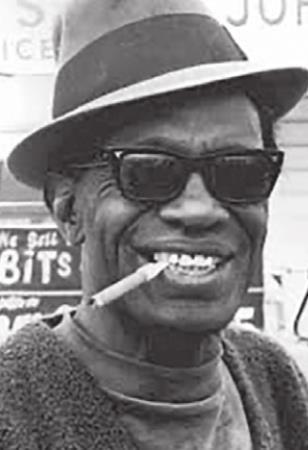
Jimi Hendrix. Duane Allman. B.B. King. Eric Clapton. Robert Johnson. When you google “who are the best guitarists of all time,” inevitably, a singular list will populate. It’s published by Rolling Stone Magazine. The aforementioned make up their interpretation of the 5 best, though the list far exceeds these names. In fact, when Rolling Stone does a list, they do it up big. There are 95 other noted musicians. Some are given. Who among us could successfully argue Hendrix from the #1 spot? And, while Whipping Post may be Duane Allman’s magnum opus, I would argue his most masterful work is the song Jessica, simply because it makes me want to roll the top down and apply a generous layer of Bonne Bell strawberry “lipsmacker” gloss without benefit of lyrics at all. But, today, we find ourselves smack dab in the month of February, noted for championing black history. I’d like to take that a step further into Texas black history. If we’re rolling the top down, actually, we may as well drive on out to Centerville, TX. We may as well run the red lights of the Rolling Stone list all the way toward the end. That’s where we’ll find Lightnin’ Hopkins, the 71st best guitarist of all time.
Lightnin’ (either Sam John Hopkins or Samuel John Hopkins, depending on who you trust) was born on March 15, 1912 in Centerville, midway between Dallas and Houston. This is the point where we would talk about his parentage, upbringing, childhood experiences and eccentricities. Except, in this case, little to no details about his early life is available. I read that his parents were sharecroppers, a common occupation for black families in 1912, just 47 years after slavery ended. I use the term family since sharecropping required all hands on deck. My paternal great grandparents were sharecroppers when my grandfather was born in 1899. Gramps’ tales of hardship and dreams of a better life took him both to barber school, and to the honky-tonk scene with his fiddle, looking for anything to do besides farming. A site called udiscovermusic.com says young Sam’s father, also a masterful musician, died when he was very young. Another site, blackpast.org, simply says his parent’s identities were unknown. Wikipedia just omits the area about parents altogether. It’s a bit muddy. One thing everyone agrees on, however, is that, at some point in 1920, young Sam’s life would change. He would find himself living in nearby Leona, TX, where he would venture out to a church picnic in Buffalo, where he would meet one Blind Lemon Jefferson. Remember Lemon? We chatted about him last February. If you asked me what my favorite column was, which one made me proudest, I would instantly say “Freestone County S-Curve.” The story of Blind Lemon Jefferson haunts my dreams. My attempts to find his resting place have not been fruitful, but I will succeed one day. Anyway, I’m not the only person deeply impacted by Lemon. Sam heard him play that day in the country. Sam would soon be spotted around town with a homemade cigar box guitar. One article credits his musicianship to his older brother, Joel, who taught him to play on that old cigar box. Other articles credit Sam’s distant cousin, country blues singer “Texas” Alexander or cousin & Texas electric blues guitarist Frankie Lee Sims with teaching him strings skills. One article swears 8-year-old Sam was already masterful on the guitar by the time that picnic occurred, that he hid behind the old church playing along with Blind Lemon until Lemon himself demanded the prodigy show himself immediately. I doubt this particular tale. Lemon was blind, after all. A blind man shouting “show yourself” to an 8-year-old at a church picnic reeks of someone’s misplaced flair for artistic liberty. One thing is for sure. Sam could make a guitar talk. Soon, Lemon would refuse to be accompanied by anyone else.
Sam went to prison around 1935, at the age of 23. No one seems to know why. About a year or so later, he was back to (his own words) picking a little guitar, picking a little cotton. In 1946, he decided it was worth another shot. Sam surfaced in Houston, busking on Dowling Street in the Third Ward. That’s where Lola Anne Cullum found him. Lola was a talent scout for Aladdin Records in Los Angeles, as well as being the wife of a prosperous Third Ward dentist, as well as being a talented singer in her own right. Some music historians say blues pianist Wilson Smith was already performing with Sam. Some say Lola introduced them to each other. Regardless, Sam Hopkins and Wilson Smith, with an extreme amount of cajoling, followed Lola all the way to LA to record the blues. Wilson’s proclivity of attacking the piano keys with fervor earned him the nickname “Thunder.” What goes better with thunder than lightnin’? The moniker stuck, though stardom did not, despite the duo recording over 40 songs for the label. So, Sam returned to the Third Ward. The story could’ve ended here, were it not for folklorist Sam Charters.
Sam Charters was on a mission in the late 50s. Fearing the burgeoning rock & roll scene could be the end for blues music, Charters wanted to preserve as much of the genre as possible. He showed up in the Third Ward looking for Lightnin’ Hopkins, hoping there were more songs, more history to capture. Charters’ efforts paid off. By the time Lightnin’ died in 1982 of esophageal cancer, he’d managed to become a legend. He recorded music for 19 different labels. He was Houston’s own poet in residence for 35 years. He performed at the American Folk Blues Festival. He toured Germany, the Netherlands, and Japan. Little Sam John Hopkins from Centerville, Texas, of vague parentage and muddy details, former sharecropper and player of cigar box guitars, stepped onto a stage in the late 60s. He could scarcely believe his eyes. Historians wrote of his reaction, “Carnegie Hall is beautiful.”
- Log in or Subscribe to post comments.