
At the end of last week’s article, I stated that the CHUCKWAGON picked up its name because Cowboys called their meals by the name of “chuck,” which is an English (British) term for “good, hearty food.”
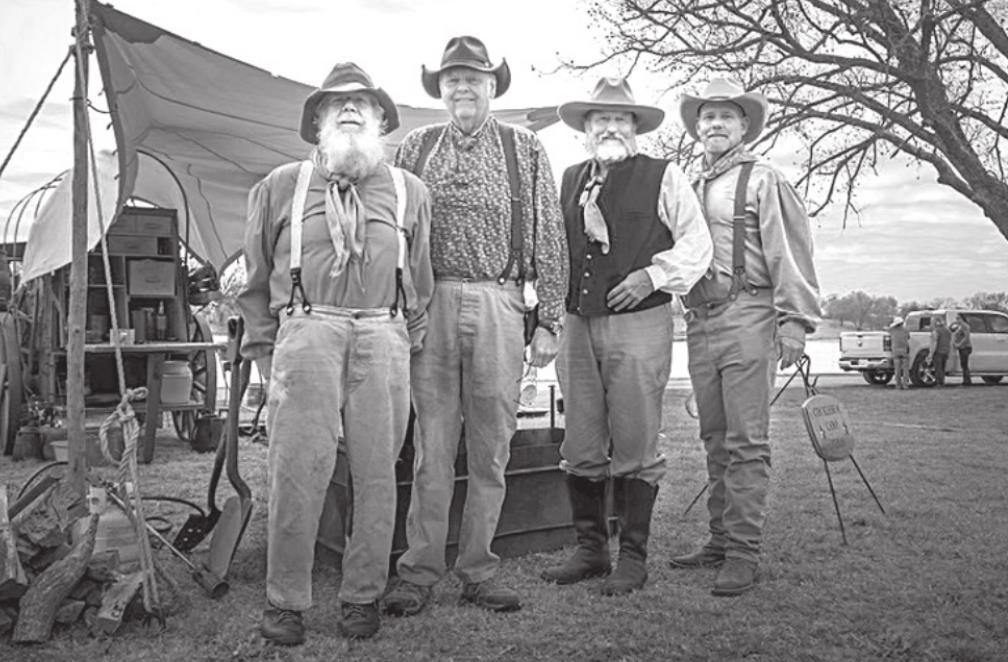
Now, let me begin by saying that Mr. Brown and I discussed his association with the American Chuck Wagon Association one day not too long ago at the Spellman Museum of Forney History, and he made his entry into the building by noticing the tee-pee (tipi) as we Forney boys called them when we watched “Cowboys and Indians” movies and then played our games by the same names out in backyards and farm pastures. As Museum Manager, Kendall Milton, and John discussed the structure, I could tell he was not just another “watcher of television movies,” because he pointed out a “flaw” in the construction that none of us had noticed, even though I now remember learning about it at Boy Scouts campouts—the draping and hanging of the canvas (hides) (baffles) to promote the drafts needed to keep the fires inside burning without suffocating the dwellers!
Anyway, Kendall mentioned we might write a “text” of the discussion to add to the display, and Mr. Brown and I made our ways into the Multi-Purpose Room to begin our discussion of his very interesting hobby—American Chuck Wagon Association—and I was immediately even more interested when I found that he is a member of the COCKLEBUR TEXAS GROUP!
I also found out that he has been associated with Boy Scouts for 40 or 50 years, including the years that his son, Randy, worked hard to become, and then did attain, the rank of EAGLE SCOUT (Troop 339). Scouting was sort of a “driveway” into becoming a “Chuckwagonner,” since camping, cooking, living with and in nature, and being able live and eat without all the modernisms of today’s life are all large parts of both! If I remember correctly, John told me he has been “doing” this new hobby of his for about 6 years and still has great fun and learns something new each time he takes part in an event!
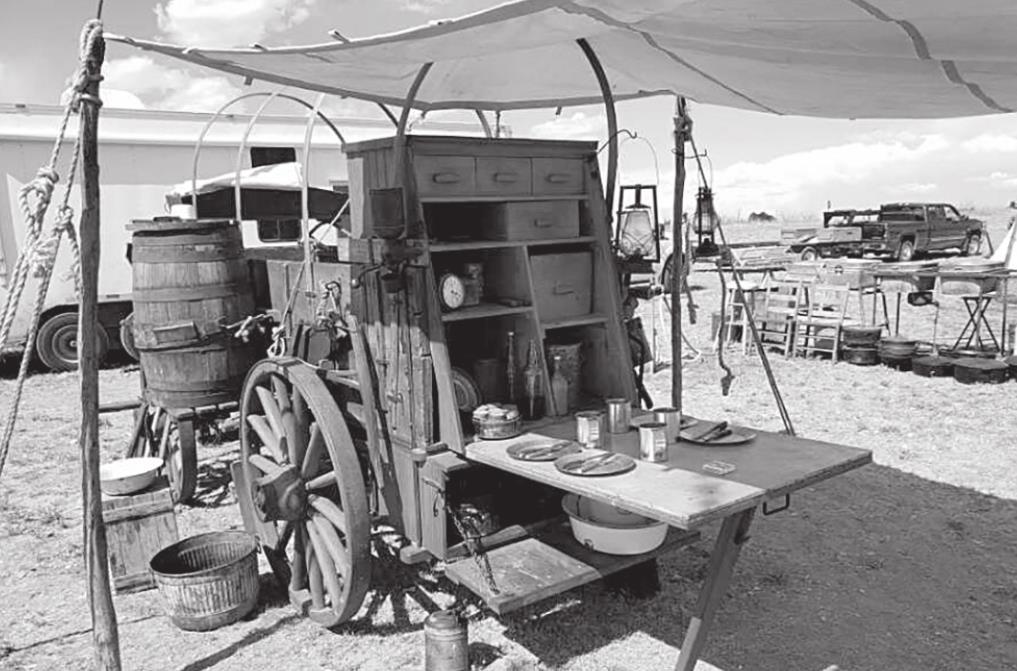
And he did emphasize a few important things that must be observed as a Cocklebur and Chuck Wagon Association member, such as (1) cooking must be done on an open fire; (2) no charcoal may be used; (3) must think large and be able to cook for 100 or more folks at one time; (4) must keep everything just like living and functioning out on the trail; (5) must be ready to have a breakfast of biscuits, bacon, and beans; (6) must be able to use a Dutch Oven; (7) must consider the “group” as “family.” (I added that one, after hearing John’s stories and reading the literature he gave me!)
And now I am going to try to condense a long, interesting story of events into a shorter story!
The real “long cattle drive” era lasted for about 20 years and was especially strong during the 1880s, but written archives and old photos show cowboys out on the open range, cooking and eating around the chuck wagon, on even into the 1930s!
On the old cattle drives, the crew lived on the trail for sometimes as long as 5 months and sometimes had disagreements, just as do most families, but one person was exempt from criticism from outsiders and was defended by the hands, and that was COOKIE; the only man considered higher in rank was the TRAIL BOSS. And like we workers had “other names” for our bosses in the break room or at parties but did not let these get out to their faces, so did the hands not call COOKIE “pot wrassler” or “bean wrangler” or “belly cheater” to his face when he perturbed them.
Cowboys had many duties, such as checking on the cows at night and keeping watch for trouble inside and out, stampedes, predators, and rustlers. But COOKIE was exempt from all these duties; however, he did more than make biscuits and stew, such as being the repairman, counselor, entertainer, dentist/doctor, banker, barber—and even the judge/referee/arbitrator during fights/arguments.
Chuck Wagon Etiquette: (1) no one eats until COOKIE calls the hands; (2) no one helps himself to food without permission/invitation of COOKIE; (3) no one takes the final piece of remaining food until all have eaten their meals; (4) eat 1st and talk later; (5) finish all your plate of food and “lick it clean,” so as not to insult the cook; (6) if riding into or from the camp, make sure to ride “downwind” so as not to “dust” the food; (7) COOKIE’S “workspace” is not the dining table!; (8) if you go to fill your coffee cup, and someone yells out, “Man at the Pot,” you are obligated to fill all “held out” cups and then your own; (9) strangers are always welcome.....
While cowboys took their shifts at various jobs during the night hours, COOKIE was permitted to sleep “through” the night, but morning for him came way before most of the hands had arisen. Around 3 a. m., he built a “new” fire, ground coffee beans, and hung the pot on a pot rack hook over the blazing fire pit so that it would be full/hot/strong for the men as they began preparing for the day’s work. Also, on the blazing fire, he would set his cast iron pots and lids and Dutch Ovens to begin heating and get ready to serve the food “on time” or else possibly be “fired” from his livelihood, or at least have his reputation and respect put into danger. He toiled, tossing in beef fat, cutting/salting steaks, kneading loaves of “bread” dough, and dropping the steaks into the hot ovens to cook while he continued on to make biscuits, dipped into tallow and baked in the bread ovens in the cooking trenches by shoveling hot coals around and on top of the pots/ovens.
Only after the “chuck” was ready, the cook said “O. K.,” and the men had “washed up” and gathered cups, knives, and forks, did the men move into the line to get their portions—no tables, no chairs, just ground, rocks, logs, or bedrolls and laps as tables/trays. When finished, the cowboys tossed dirty dishes, utensils, and cups into the “wreck pan” (large bin) to avoid the wrath of COOKIE if they did not!
As soon as the hands saddled horses and rode off, COOKIE went into action, preparing for the next meals by.....
Return next week for more action from the cattle drive.
- Log in or Subscribe to post comments.