
1851—1872½: Kaufman’s “hold” on the County Seat was firm and secure!
1873: Terrell was “founded” on the Texas and Pacific Railroad route and rapidly surpassed Kaufman in population. Talks informally began about moving the county seat. Talks became debates, but nothing was done!
1879: Terrell’s population soared to approximately 4,000, while Kaufman’s shrank to maybe 300! Terrell folks argued that the county seat should be amidst the center of population and wealth rather than geographical center; the courthouse and jail were outgrown, old, flammable, and in bad condition, and the same folks said that a new courthouse and jail could just as well be built in Terrell as in Kaufman. “Kaufmanites” countered that things were not that bad and could easily last another five or more years, but on August 29, 1879, County Judge H. P. Teague called an October 4th election to vote on the petition concerning whether the county seat should be moved to Terrell from Kaufman.
The Ft. Worth Daily Democrat reported on September 21 that Terrell was selling/giving away “removal drinks, removal beer, removal cigars, removal hash, and removal many things.” It also reported that Kaufman was “shaken from centre to circumference over the county seat removal question and debating fiercely!”
RESULT of the election was 1,711 votes for Terrell and 1,232 for Kaufman; Terrell failed to get the needed 2/3 majority to win the election and county seat by 251 votes! *By law, another “removal election” could not be called for another five years, but “Terrellites” felt extremely confident they could overcome in the next “go ‘round.”
August, 1881: Kaufman secured a railroad connection, and by 1885, their population increased substantially to 1,200 or more, but the small frame courthouse was still deemed a fire hazard and in danger of being lost, so, in July of that year, Elmo folks circulated another petition (signed by more than 200 voters) for a county seat election, presented it to the Commissioners’ Court—and an election was set for September 19.
Both Terrell and Kaufman campaigned much harder and with more intensity than they had in 1879—the Kaufman Eagle and the Terrell Daily Triumph were papers written and published especially for this election. The two towns used “economic arguments” to help win the election, because both knew that the winner would benefit monetarily.
Terrell pushed the point that “one great town” was needed to lead the county, while Kaufman stressed that “two strong towns competing head-to-head” would be better for economic and population growth.
A Terrell group of citizens signed a bond for $30,000.00 to build a new courthouse if the county seat were moved there, while Kaufman citizens pointed out that such a bond was not legally binding and that Terrell was too far north for the people of the southern parts of the county to visit/come to “trade” easily. Numerous debates were held throughout the entire county!
September 19, 1885: The election was held and votes counted that same night—2,501 for Terrell and 2,168 for Kaufman—Terrell lost by 612 votes, because a 2/3 majority was needed to effect the change. Terrell was “stoic,” but unhappy about the outcome, but accepted it, while Kaufman celebrated much more than with the other elections— parades, fire-works, bonfires, and open rejoicing! In December, the County Commissioners voted to build a new $60,000.00 stone COURTHOUSE in Kaufman, and this move basically settled the “moving of the county seat” question permanently!
How many “new” courthouses have there been? AT LEAST FIVE!
By February of 1852, Commissioners provided “that certain elections would be held at the Court House in the Town of Kaufman,” and it was not on the Courthouse Square but on the southwest corner of Washington and Mulberry Streets and was a “one-room frame structure, twenty by thirty feet.” However, this building soon proved to be too small and too costly to repair; therefore, the Commissioners in 1858 arranged to have plans drawn for a new courthouse! Hugh Yarbrough of Tyler submitted the best bid for construction, and bricks were made in Kaufman, while lumber most likely came from Henderson County.
April, 1861: The 2nd Courthouse (two-story brick and forty-four feet square) was complete, with the “court” upstairs and four offices downstairs! It was accepted by the Commissioners at a final price of $525.00 less than the contract price. (Does that happen very often today?) There was immediate controversy as the Chief Justice argued that the materials were inferior and protested paying even the reduced price—but he was over-ruled, and the building was occupied on May 20, 1861.
BUT GUESS WHAT? Cobb was apparently correct, because efforts to “correct deficiencies of the building” at the end of the year were unsuccessful, and the building was abandoned and declared unsafe for public use in December of 1862.
Rental offices were used for a while, but soon officials moved back in to the old wooden courthouse (May, 1863) after repairs to the building were made, and it was used throughout the remainder of the Civil War!
June, 1868: the wooden courthouse was declared “unsuitable for use” and later burned while it was being used as a “blacksmith shop.” Courts, then, were temporarily held in Kaufman churches until the County could build its 3rd courthouse.
July, 1869: Carpenter, James Brown (no known relation to the famous singer), received the contract to build the new courthouse, which was put into use in 1871 but not totally completed until August, 1872, when a twostory, 50 feet square building with four downstairs rooms and one courtroom upstairs, was complete! It was the largest that the county had ever had, but it, too, soon proved to be too small and was also considered dangerous as a fire hazard, since it was made of wood!
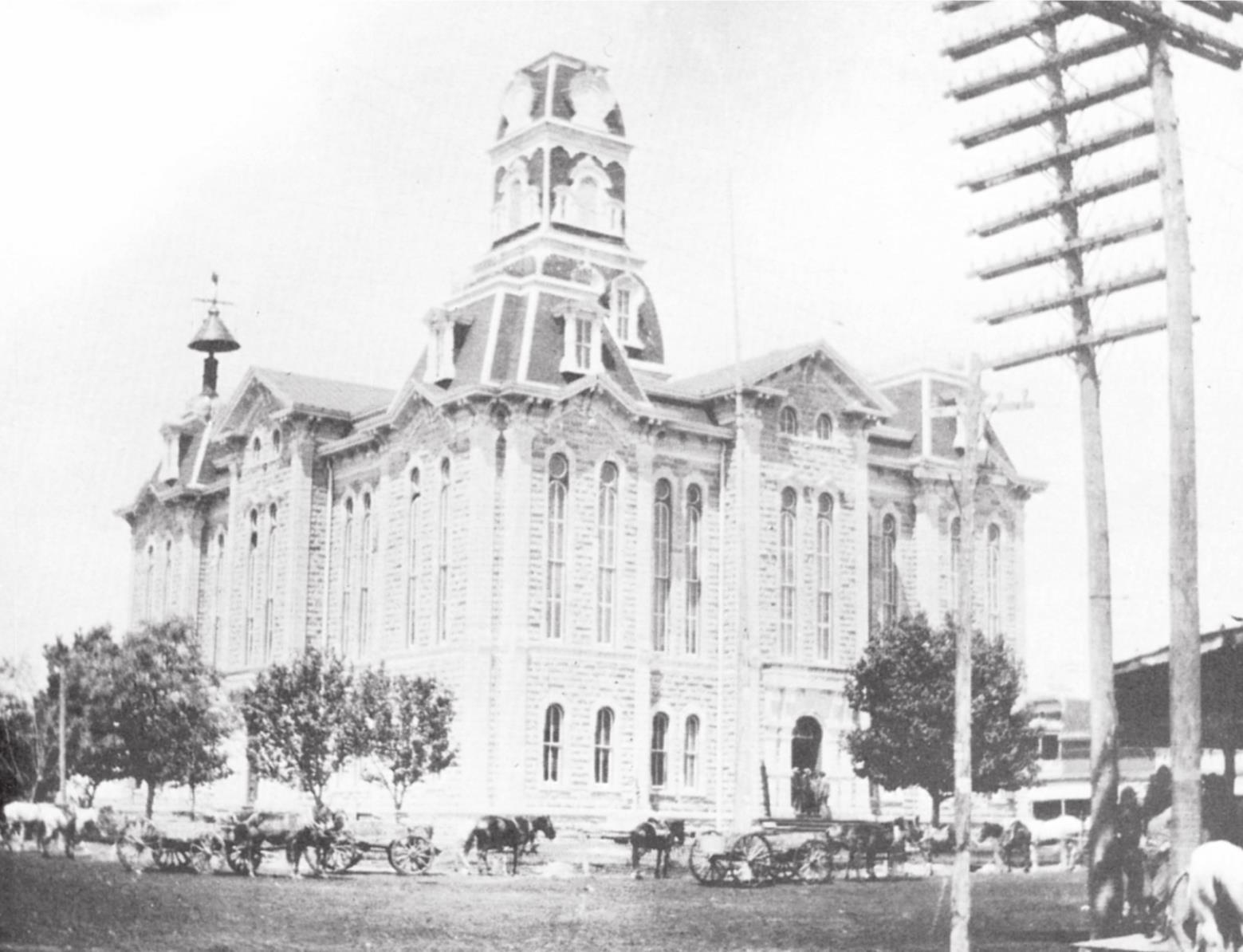
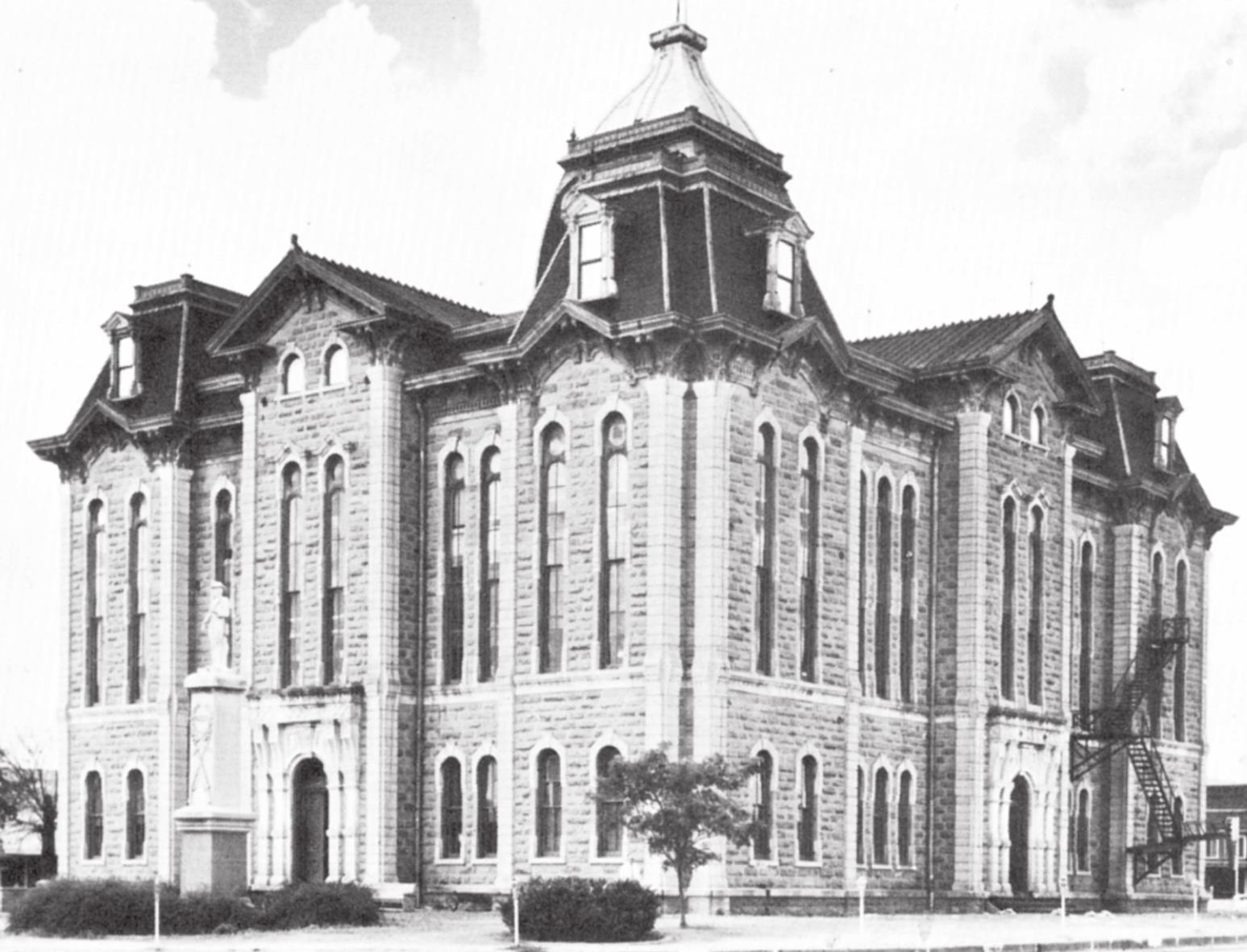
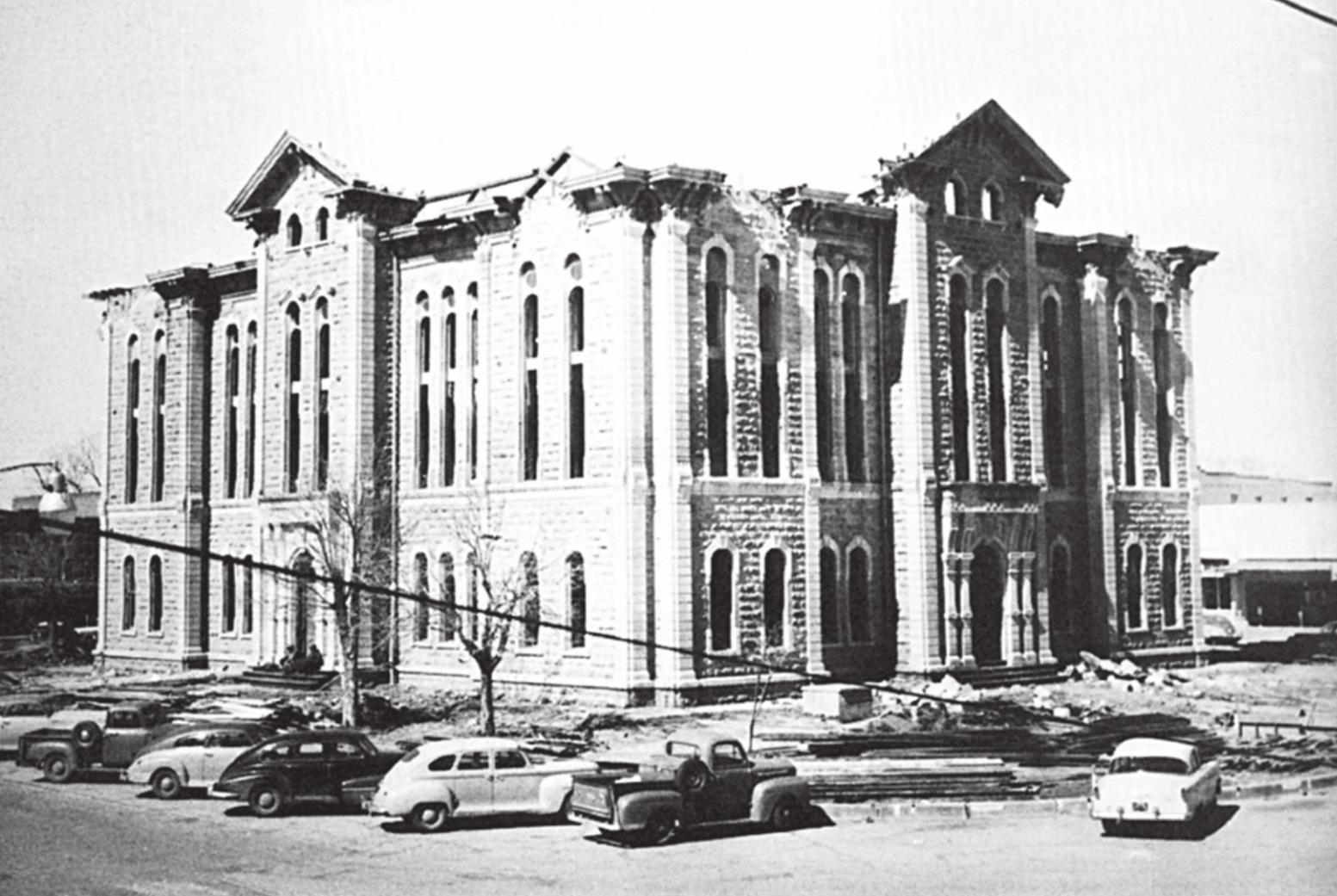
This concern remained constant, even as Commissioners built other smaller buildings (The masonry ones again cracked!) to help relieve the over-crowding, and after the 1885 election guaranteed that Kaufman would remain the county seat, Commissioners in December voted to build “a new, fireproof, stone courthouse, which was accepted into use in July of 1887. The frame courthouse, which had been moved next to the jail, was demolished after the “acceptance.”
4th Courthouse details: 98’ by 114’ with 60’ tall walls and 124’ to the top of the tower—each building stone personally inspected by the architect—3 stories and resembling the Weatherford Courthouse—I will not give foundation and walls, and beams and other construction dimensions, but believe me when I say “thick and sturdy!”—Aubrey, Solan, and Laude won the bid!—old courthouse moved to adjoining lot for use during construction of new and then to be moved to the “Poor Farm.” This grand building served the County for more than 70 years, but a “working clock,” which was supposed to be installed in the tower, never was “placed.” The dome with “artificial clocks” was removed around 1900 after being struck by lightning many times! The Confederate monument of General Robert E. Lee was erected in 1911 with funds raised by the Daughters of the Confederacy.
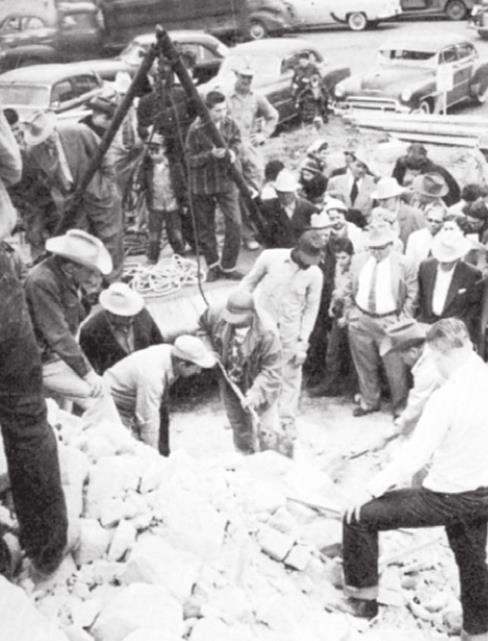
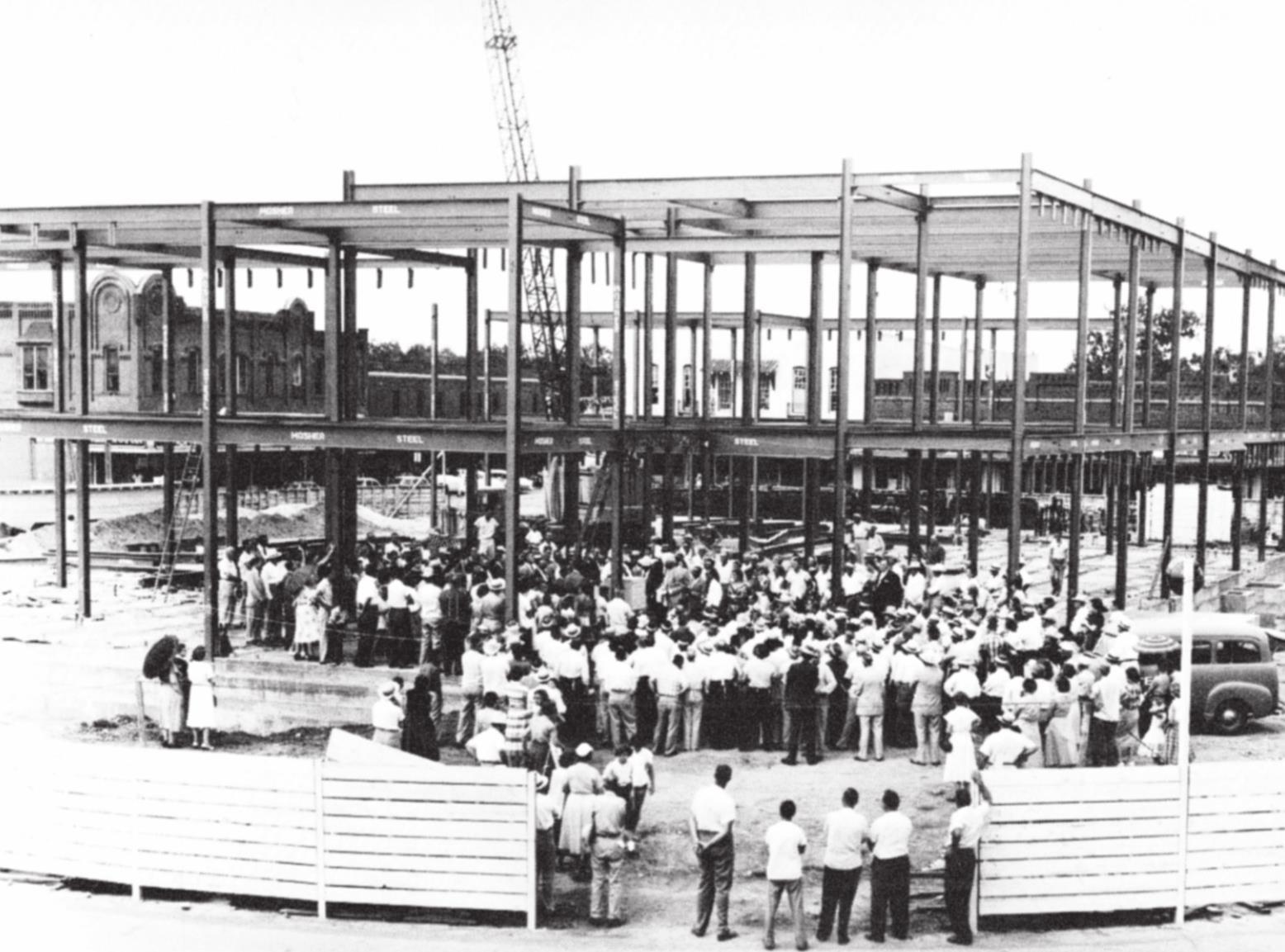
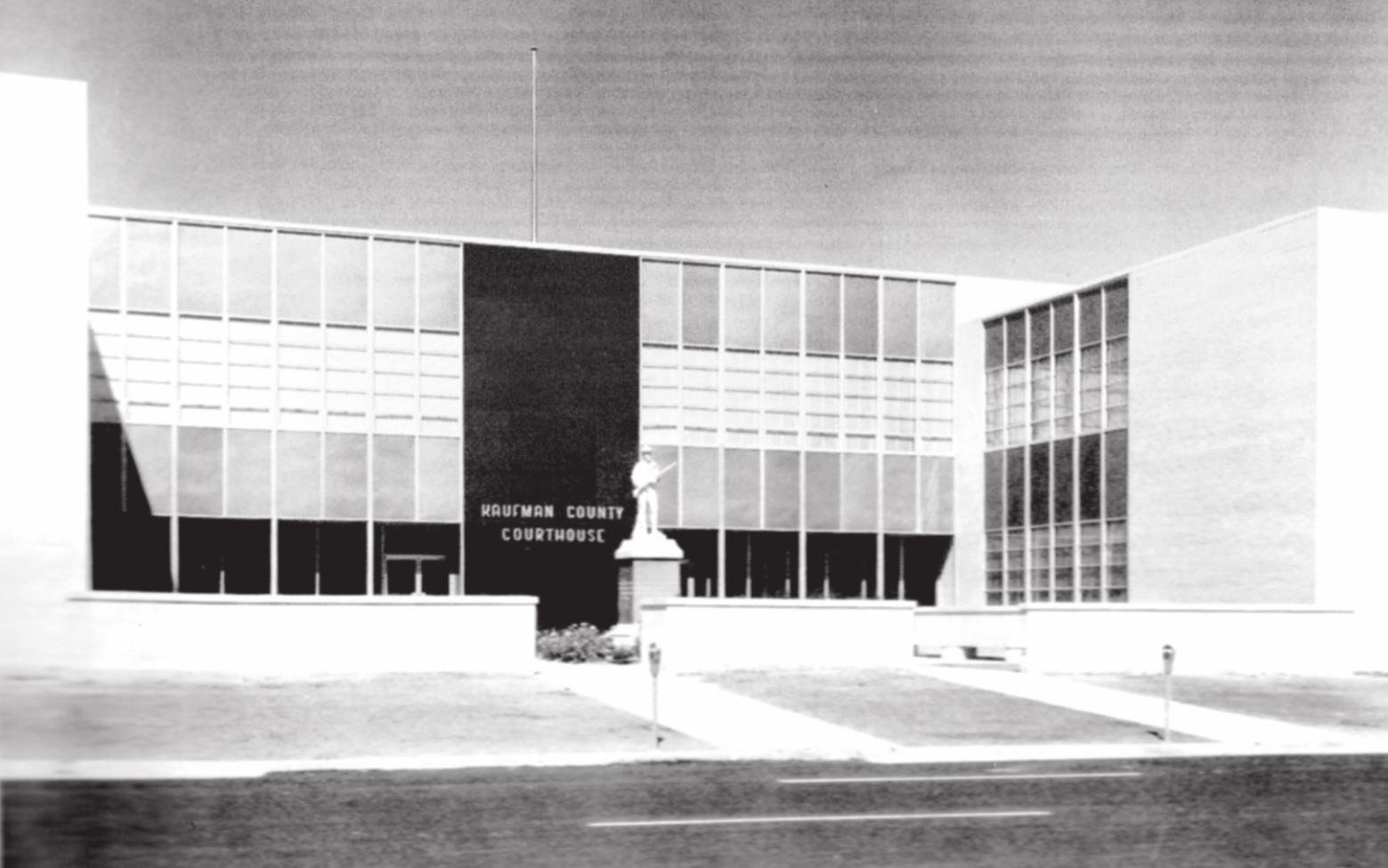
1955 is the year the grand old stone building was torn down to make way for a modern two-story building with ground-breaking ceremonies in March. Former County Judge, Fred W. Bankhead, County Judge when the new building was authorized in 1954, turned the first shovel of dirt! The Confederate monument was polished and placed in the courtyard of the New Courthouse.
*Interesting to note, the moving of the large, old, frame courthouse cost a “whopping” $450.00.*
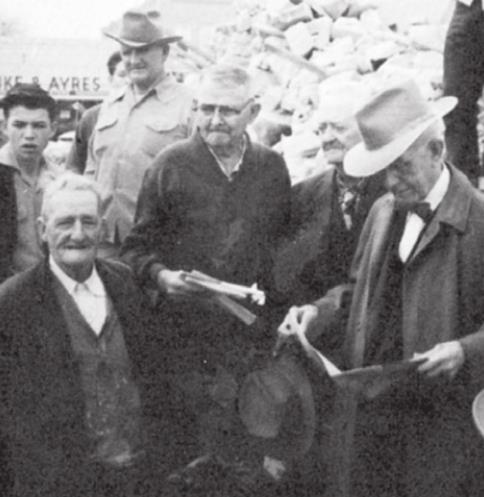
**Doubly interesting, at least to me, is that Dixie Brown, Marion Fox, Guy Spencer, and W. D. Adams (Forney), who witnessed the laying of the courthouse cornerstone in 1886, were present for the new opening in 1955!**
- Log in or Subscribe to post comments.