

And there’s two white horses following me/And there’s two white horses following me/I got two white horses following me/Waiting on my burying ground. Did you ever hear them church bells tone/Have you ever hear that church bells tone/Did you ever hear them church bells tone/ Means another poor boy is dead and gone.
Five miles west of Streetman, TX, right off FM 489, smack dab in Freestone County, William Coutchman bought acreage and started a town called (drumroll) Coutchman, back in 1850. That’s all we know about Mr. Coutchman. The spelling of both his name and the town are subject for debate, as they are often referred to as Couchman. In its heyday, Coutchman had a post office and a population of 300 people. But, that was back in 1894. By 1905, Coutchman’s mail was diverted to the post office in Wortham, TX. When the 1910 census was published, Coutchman had a population of 100. By 1980, there was no census listing reported at all. Coutchman isn’t even a ghost town, these days. It just isn’t there. In fact, there’d be no reason to speak of a settlement that never took, that was wiped off the face of the earth by circumstances that weren’t even important enough to be recorded, except for two things. Thing 1 lies in the town’s origin. Thing 2 lies in the town’s favorite son.
If you’re tooling through Wortham and take the S curve just west of Cedar Creek, on the right side of the road, on Rudy Miller’s land, there’s a small cemetery. There you’ll find the Couchman Cemetery (minus a t), the final resting places for the Powells, Josephus and Margaret, who were married in 1874. There are Couchmans, too, like Benjamin and Ruth, who were married in Indiana, but appear in that Texas census from 1850. The records for this tiny cemetery were kept about as well as ones for the town. Many of Ben and Ruth’s successors are buried there, but most are not. Historians really aren’t sure what to make of the missing headstone information or the burial locations of more of this clan, since historians likely have never heard of Couchman or Coutchman. Oh, did I neglect to tell you that this was an African American cemetery? It is, just like Coutchman/ Couchman was likely a mostly African American settlement that turned into a town that just vanished. Tragically, headstone analysis tells us this resting place predates the formation of the town of Coutchman. And yet, it’s all that’s left, except for the music.
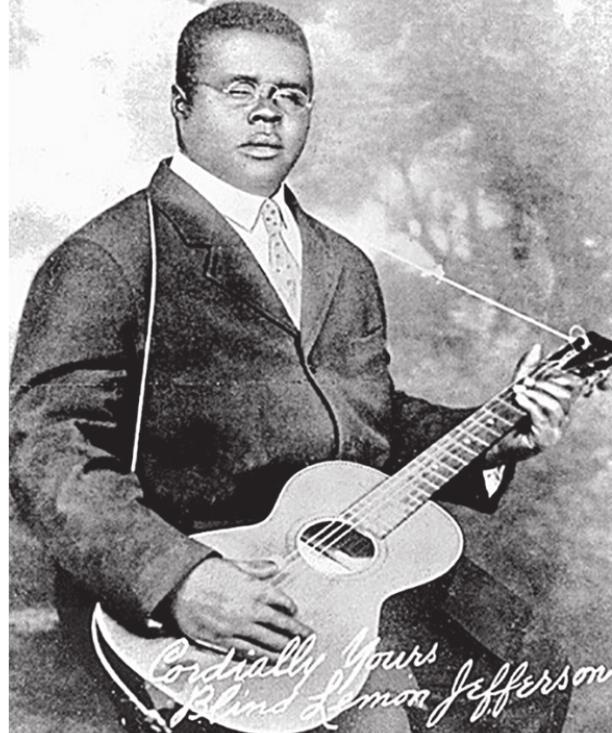
Alex and Clarissa Jefferson lived in Couchman, TX. They were sharecroppers. That’s the entirety of their story. We don’t know how they came to Texas or to Freestone County. No information exists as to where they are buried. They farmed. They struggled. They had seven children. I’m sure their children were a blessing to them on the farm they tended. Sharecropping was brutal work. You supply all the effort and the time. You pray for rain. You pray away the grasshoppers and the crows. You break your back in the sun with the one plow and mule you possess, and you get paid nothing, save a ramshackle single room house and a portion of the crop. I’ve heard stories. My father’s people sharecropped in Ellis County, near Bristol, around this same time. In 1893, the Jefferson’s had 6 children in the field and one on the way. On September 24th, Clarissa gave birth to a son, Lemon Henry Jefferson. She knew from the moment she held him; this one was special. Lemon was born blind. Soon, he would have a guitar in his hands.
By the early 1910s, Blind Lemon Jefferson, as he was known, had become a fixture in the Dallas music scene, having cut his musical teeth busking on East Texas street corners. Times were rough out east, but local bootleggers took a liking to the young guitar prodigy. He would play. Folks would come listen. Folks would buy more hooch. He soon became a figure in Deep Ellum, meeting and gigging with Lead Belly. Lemon taught blues pioneer T-bone Walker how to play the guitar. By the early 20’s, mention is made of Lemon’s monetary success in Dallas and the possibility that he was able to support a wife and child, though no other mention of relationships or children is recorded.
Lemon was endeared by the blues community in Dallas. While black blues recording artists pre-1920 were rare, Lemon’s associates took him to Chicago to record tracks. His sound, old time picnic meets honky-tonk rag meets street corner blues, paired with his impressive vocal range, made Lemon impossible to imitate and difficult to forget. Both Okeh Records & Paramount agreed, and signed him to deals along the way, producing multiple versions of his biggest hit, “Matchbox Blues” with “Black Snake Moan” on the B side. In 1927, Lemon, as a tribute to his mother, recorded an album of gospel songs under the pseudonym Deacon L.J. Bates, including the highly successful “See That My Grave Is Kept Clean,” sampled at the beginning of this article.
Blind Lemon Jefferson died at 10 am on December 19, 1929, in Chicago. The details surrounding his death are about as clear as the history of Coutchman, TX. The Chicago rumor mill churned out a tale about a jilted lover and poisoned coffee. Other accounts have him succumbing to a heart attack after a midnight dog mauling. Dallas Morning News reporter Frank Tolbert claimed to have proof that he was killed during a robbery while carrying a large record royalty payment. His death certificate states, with a dubious amount of certainty, “probably acute myocarditis.” In 1967, a Texas historical marker was placed, hopefully, near his mysterious, unmarked final resting place, not with the Rudy Miller’s land clan, but in the Wortham Negro Cemetery, since renamed Blind Lemon Memorial Cemetery. For every tiny internment, past every rural route S-curve, there lies an untold story, just waiting for a snake to moan it to life.
- Log in or Subscribe to post comments.