

Spring brings many gifts, especially here in the south. The temps begin to warm. Everything gets a dose of Mother Nature’s balayage, rapidly morphing from brown to emerald green. The world is suddenly full of babies. From ducklings to kittens to calves, the spring birthing process is truly a miracle to behold. And, for those of us deeply steeped in this mom life (or, in my case, this grandma life) it’s time to get busy. Sure, we’ll be mowing and pulling weeds and planting everything from tomatoes to periwinkles, but we also need to focus on the task at hand. There are so many eggs to dye, so much change to scotch tape into little plastic orbs, so many baskets to fill. After all, what would spring be without millions of pieces of green plastic grass to haunt us for the next 364 days? It’s Easter prep time! And, like all the other religious based holidays, this one being my favorite because the reason for this season takes us from the depths of despair to divine elation, Easter is truly a people soup of cultures and beliefs. Take the German influence, for instance. What is it about Germany and little furry creatures? First, they gave us the groundhogs, via the absence of hedgehogs in Pennsylvania. Now, you’re telling me they gave us the Easter bunny? That I am. But, before we talk all things das kaninchen, we must address the age-old quandary. When is Easter and why is it freezing cold on some years and steaming hot on others?
For obvious reasons, I love the moon. Emojis have no place in newspaper columns, otherwise I’d insert the wink face one right here. Lunar phases control just about everything. Mrs. Thatcher, wherever you are, I really did listen in 7th grade Life Sciences class. The gravity of the moon pulling on the earth causes tides to rise and fall. The initiating circadian rhythm governs everything from migration patterns to reproductive cycles, for both animals and humans. The moon even triggers coral spawning on The Great Barrier Reef. And, the moon dictates when we celebrate Easter, aka the first Sunday after the first full moon following March 21st. If you’re thinking that using lunar hooey to figure out whether your sleeveless polka dot church dress needs a Jackie Onassis inspired pearl button cardigan to keep you warm sounds uber pagan, well, you’re right. Many Easter celebratory acts, like egg decorating, for instance, were initiated as a calling out to Gods and Goddesses of fertility – or so the story goes in the Ukraine. Even the term, Easter, is a direct correlation to a west Germanic spring Goddess named Eostre, the Anglo-Saxon fertility Goddess who ruled dawn and light. Even Jacob Grimm says so. Yes, I mean Grimm as in one of those brothers responsible for my lifelong nightmare of being trapped in an oven by a witch. Jacob’s extensive research into Easter reveals a pre-Christianity observance of spring. After the Germanic tribes were converted, post 4th century, the name Easter remained, but the teachings were revamped to include a biblical focus on the death and resurrection of Jesus Christ. But, just as a Saint named Nicholas has no technical correlation to the birth of Christ, the furry bunny has little to no connection to his resurrection. Or does he? To suss this out, we must travel back to Germany, once again. But first, let’s talk chocolate and rabbits that cluck.
Wait, what is that off in the distance? Mountain? Volcano? Nope. It’s just one year’s worth of Cadbury eggs stacked into a mound. Yes, Cadbury, the Uxbridge - London based confectionary company founded in 1824, produces 1.5 million crème eggs every single day from their factory in Birmingham, England. That means, should you pile them all up, by years end, you’d have a collection of FIVE HUNDRED MILLION chocolate eggs that would be TEN TIMES taller than Mount Everest. While many of us (cough, me, cough) can’t bear to experience an Easter season without at least a few Cadbury eggs, it’s not like Cadbury invented them, right? Well, practically, yes. There was another 19th century British chocolatier company in Bristol, the Fry family, who “invented” a hollow chocolate egg that could be stuffed with other, colorful, candy coated chocolate eggs, back in 1873. Rumor has it the Cadbury brothers, John and Benjamin, Quakers who sold tea/ coffee/and drinking chocolate, were mesmerized with the Fry delicacy. So much so, they dreamed up a way to combine the velvety texture of their drinking chocolate inside a very Fry-ish chocolate eggshell. But, don’t cry Fry for me Argentina. Both companies did well, deciding, in the 50’s, to combine forces and take over the choc-egg world with a merger. So, if you think Cadbury when you think Easter delicacies, I say you just have good taste. And, finally, let’s go to Germany, ja?
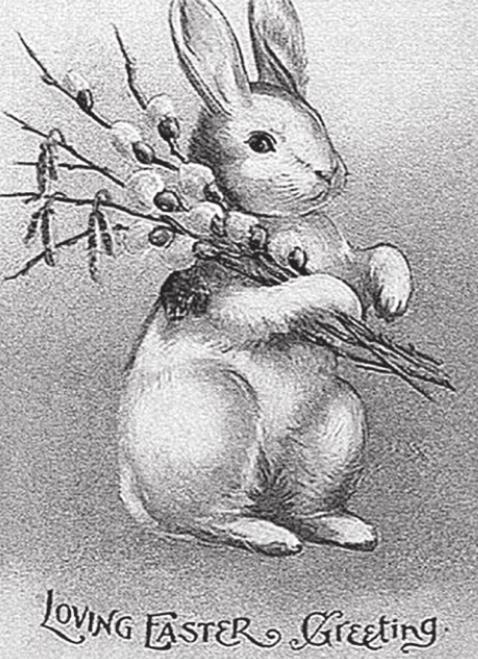
When you think rabbits, you think rapid reproduction. No wonder nearly all pagan factions recognized the hare as a sort of fertility symbol. In medieval times, it was widely believed that hares were hermaphrodites & able to reproduce without loss of virginity. This led to an association with the Virgin Mary. German artist Albrecht Durer is famous for his elaborate woodcut scene of the Holy Family with 3 hares representing the Holy Trinity, circa 1496. (It’s incredible, please google that. You’re welcome.) But, in a very Grimm-like turn, the hare took a judgy stance, courtesy of early Lutheran folklore. The hare alone would decide the fate of the children, based on a solo call regarding obedience, or the lack thereof. Protestant German immigrants brought their overly critical Osterhase (Easter hare) to Pennsylvania in the 18th century, where we, the melting pot of America, softened him into a sweet, britches & vest wearing bunny who showers our children in jellybeans and a Mount Vesuvius of Cadbury chocolate. Here’s to a beautiful and contemplative Easter Sunday. May your polka dots need no sweater. May your bunnies be abundant. May we all rejoice in another year in this beautiful world.
- Log in or Subscribe to post comments.