

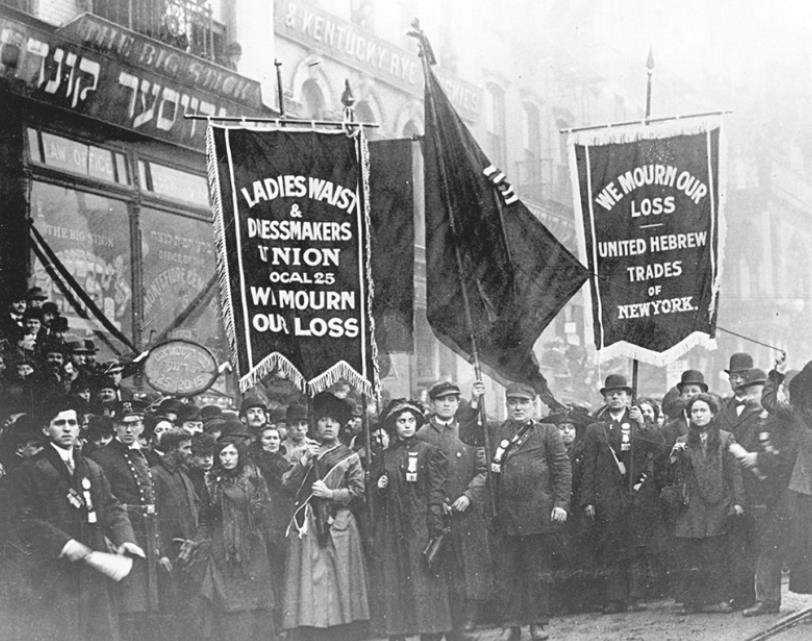
When the 500 female employees of the Triangle Shirtwaist Factory came to work in Manhattan on March 25, 1911, they came with scant expectations. The concept of women in the workplace was not held in any esteem in this era. Poor women worked. Period. In fact, the majority of the factory’s employees were recent Italian and Jewish immigrants. While the youngest employees were around 14, it was common knowledge that practically any age of immigrant was eligible to work, provided the proper documentation could be forged. The options were simple. Sew women’s blouses for 60 hours a week to earn your $7 (for the entire week), or starve. Max Blanck & Isaac Harris, the owners of this establishment, weren’t concerned with safety measures or proper ventilation, hence the term sweatshop, because there were no labor laws protecting women. Their rules were simple: show up on time and work. Wanna break? Show up late? You’re out of luck. Starting time meant lockdown time for all doors & stairwells into and out of the 8th, 9th, & 10th floors of the Asch Building in Greenwich Village. The details on this day get fuzzy. Blanck and Harris were both on the premises this particular Saturday afternoon, with their children in tow, leading authorities to believe they weren’t culpable for the tragedy we’re about to discuss. Yet, they’d had very similar issues at four of their other companies. Whether it was a discarded cigarette tossed into two months’ worth of fabric cuttings in waste bins that were rarely emptied, the motors on long underserviced sewing machines, or the knowledge that something must be done since sales were down drastically on the now less popular garments, one thing was certain. The factory was on fire and there was no way to escape for many of the employees. In a macabre game of telephone, a bookkeeper on the 8th floor was able to contact the 9th floor, but there were no alarms and no phone system on the 10th floor. The fire department arrived, but were unable to intervene. The fire truck ladder was only tall enough to access the 7th floor. By nightfall, 146 people would be dead because of asphyxiation, the collapse of the single fire escape accessible but poorly anchored, burns, and willful jumps. The oldest victim was 43-year-old Providenza Panno. The youngest was 14-year-old Rosaria Maltese. Blanck & Harris were cleared of any wrongdoing and collected on their insurance policy at a later date.
The tragic irony of this story lies in another event that took place in New York just 3 years prior. In 1908, thousands of women descended to the streets to march for better labor laws and conditions. In fact, they weren’t alone. Hit the fast forward button on that march and we find an interesting concept introduced at the International Women’s Conference of 1910 in Copenhagen. Soon, all industrialized countries would hop onto the US fair labor for women bandwagon. This included the Soviets who adopted this movement as a national holiday in 1917. But, due to the Soviet Union’s ties to socialism, the US opted to bow out of any formal association with the Copenhagen initiative and elected to pursue their own version of labor reform for women. After all, the US suffragette movement was reaching a fever pitch around this time. Yet, it would take America another 58 years to officially recognize a single day dedicated to what we focus on in this column today, “to recognize the fact that securing peace and social progress and the full enjoyment of human rights and fundamental freedoms requires the active participation, equality, and development of women; and to acknowledge the contribution of women to the strengthening of international peace and security.” This wasn’t enough, in the opinion of the National Women’s History Alliance, an organization frustrated with the complete absence of this information in the public-school history curriculum. Their solution was the creation of Women’s History week during March of 1978. By 1979, after a speech by a NWHA member, Sarah Lawrence College would back the initiative and female leaders began to seek judicial support. A presidential proclamation by Jimmy Carter in 1980 would recognize the week of March 8th as National Women’s History Week, while a grass roots public school campaign would unofficially dub March as an entire month dedicated to the cause, with an official nod by Congress one year later.
While we often think of suffragette icons like Susan B. Anthony or Mary “Mother” Jones (Irish born American schoolteacher and dressmaker who became a major union organizer and activist), civil rights activists like Shirley Chisholm or Ella Baker, celebrated whistleblowers like Karen Silkwood or Crystal Sutton (Union organizer the movie Norma Rae was based on), or modern-day women icons like Stacey Abrams or Malala Yousafzai, one thing remains clear. We alone are our own best advocate. We have a voice. We have a story. As women, we keep these principles close to our heart, because on an awful Saturday in 1911, the day young Rosaria Maltese and 145 of her coworkers perished, reporter William Shepard said these chilling words. “I learned a new sound that day, a sound more horrible than description can picture – the thud of a speeding living body on a stone sidewalk.” Today’s sources include Kathy Durkin’s article in Workers World (A Rich Tradition), Charles Kerr’s “The Autobiography of Mother Jones,” & articles published on the Triangle Shirtwaist Factory Fire by The History Channel.
- Log in or Subscribe to post comments.