
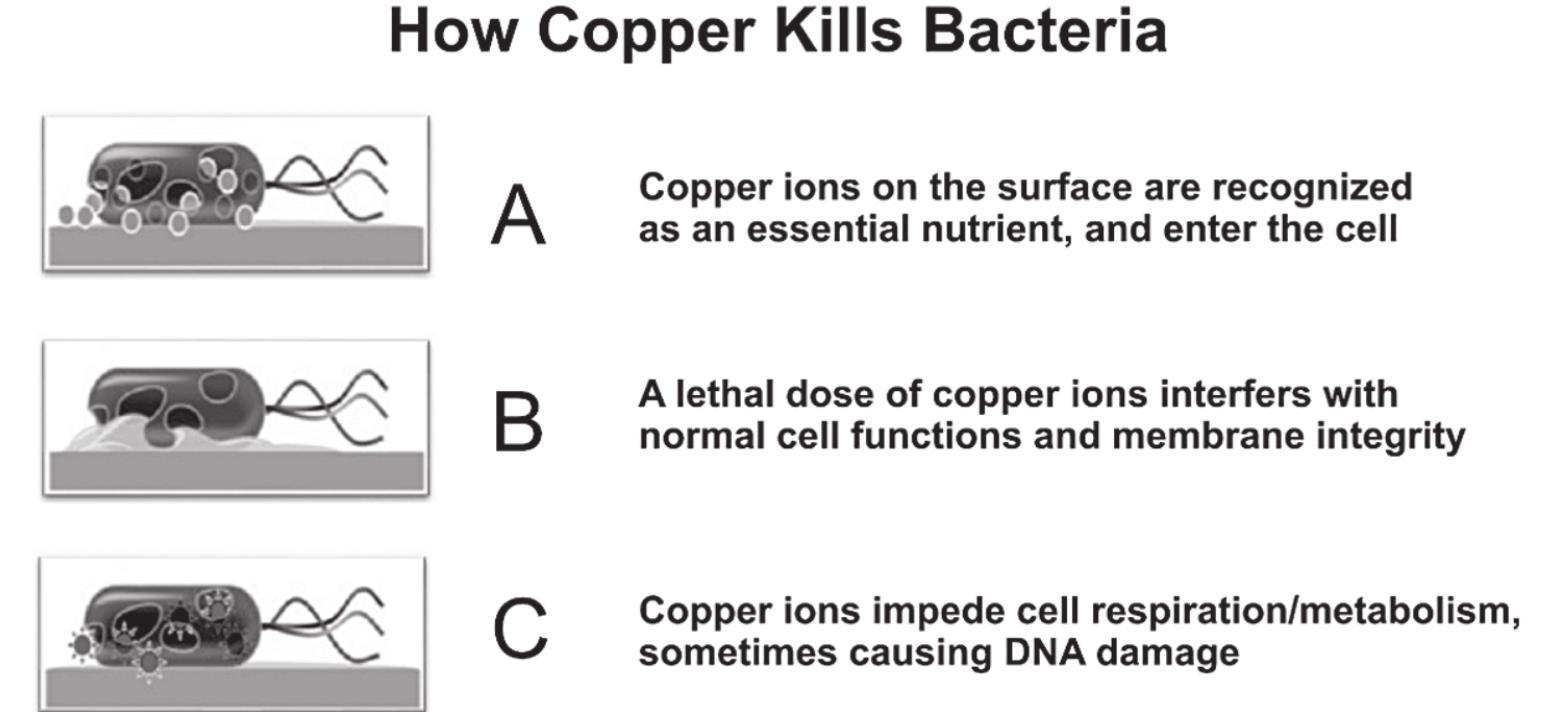
The “THEM” mentioned above is MICROBES, which can continue to be dangerous for up to three days on stainless steel, plastics, and various other metal and “slick-finished” surfaces, while about three or four hours is their survival time when on copper!
Go way back to ancient times, and references allude to using copper for sterilizing drinking water to make it safe for consumption and treating wounds to avoid or cure infections.
A recent study by researchers discovered that nearly 90% of the samples that had been taken from traditional hospital beds during their study had “unsafe” levels of bacteria— even when they had been regularly cleaned and disinfected.
And, sources indicate that the average cost for treating “hospital-caused infections” is about $30,000 for each incident.
However, beds constructed with copper for important areas—controls, rails, and footboards—averaged approximately 94% fewer bacteria when tested.
So, what does this mean? Switching to copper for standard construction of “medical beds” should reduce the risks of infections that are commonly acquired in hospitals. And, although we all can deduce that not all infections can be stopped by widespread use of copper, the 100,000 Americans who become “infected and die” in hospitals and the 2,000,000 who have their hospitalizations lengthened and/or their diseases made more severe could certainly be made safer and more secure and “out” far less money spent for treatments!
Let’s continue this discussion to an area that also deals with thousands or even millions of people each day—commercial locations, such as airports and planes, bus terminals and busses, train stations and trains—and “communal” gathering points, such as schools, businesses, playgrounds, restaurants, museums—think how the widespread use of COPPER for “common areas” in them could help slow CoV-2, COVID-19, SARS, and various strains of “killing” or “sickening” bacteria!
So, just how does copper kill the microbes? When copper “oxidizes,” it loses electrons and makes an “oxide” of itself, and that is known as “cuprous oxide.” (Cu2O).
When it is in this form, the “redox” binds copper atoms to oxygen atoms, which are then in a state of constant exchange of electrons. This makes cuprous oxide just unstable enough to disrupt organisms at microscopic levels—the perfect army against micro-organisms that cause illnesses and diseases.
Now, I know this is perfectly clear to all of you who had Mr. Bob Lucas for a chemistry teacher, but for the rest of you, let me continue with one method by which the destroying takes place. There are five ways, according to materials I am reading, but suffice it to say that if you are interested enough in the science and medical information to understand the other four, I know you will take it upon yourselves to go to your chemistry books or the internet to learn more!
Here is the first way. The “metal,” copper, reacts with water in liquid form or in air moisture, and this is oxidation, which we know as “rusting” as we see it on various of our “daily” metals in use.
When rust molecules are formed, the copper pulls electrons from the membrane of the bacteria’s cell wall lipids, either oxygen or proteins.
To make a long story shorter, copper atoms that are oxidizing weaken the bacteria when they pull these electrons from the atoms that make up the cell walls. Just as pulling bricks from a masonry wall eventually causes the wall to weaken and fall, eventually the cell wall also breaks and kills the bacteria. So, rusting copper is exactly the surface location we want when GERMS are present!
P. S. I am glad I was a social studies and English teacher!
- Log in or Subscribe to post comments.