

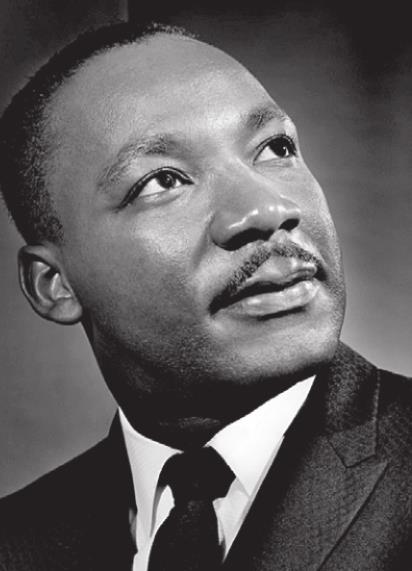
Note: this column was authored before the events that took place last week at the US Capitol. In lieu of our topic, we have to take a tack from history. In the case of the Holocaust, or the day of 9/11, or the horrors of both our civil and international wars, to stop talking is to forget, to forget is to repeat. If 2020 has taught us anything, it’s that repeat performances of horrible things actually CAN happen, and often do. As you read this column, you might not even realize what Monday holds for you. For many with office jobs, you get a day off. It’s Martin Luther King Day, after all. Why, if it were summer, we’d all be donning our flag festooned swim trunks and bikinis and cooking out at some lake, indulging in adult beverages and playing horseshoes or corn hole with Kidd Rock in the background, rocking a bad word for a woman up and down the coast. After all, what are national holidays for, if not this? A national holiday is a country’s equivalent of a personal milestone celebration, like a birthday or an anniversary. Our forefathers thought it would be nice for us to take a day and remember our history and celebrate as a society. I’m not sure they meant for us to confuse Veteran’s Day and Memorial Day, but that’s a column for another time. I’m not sure they meant for us to choose to show up at the post office only on these days, cursing under our breath because we really needed stamps. But, it’s just MLK Day, the national holiday that almost wasn’t. Do you remember all that controversy over the American people not needing yet another day off? Still, I happen to think it’s the most important one of all. But first, let’s hop into my hot tub time machine and head back to the 40’s when Michael King (who would legally change his name to honor Protestant leader Martin Luther) forged his path. I’m embarrassed at how little I knew about this civil rights icon. We shall learn together, yes?
Young Michael King was an intellectual phenomenon, completely skipping grades 9-12 before heading off to Moorehouse College at 15, his father’s alma mater. He would go on to receive a Doctorate in Systematic Theology. He was also an accomplished piano player just like his mother, honing his musical skills in the Baptist Church. Friends and relatives remember the child version of MLK as being just as funny and mischievous as they come, absolutely hating having to do the dishes but loving a good game of Monopoly and a bowl of ice cream. He was known to pop the heads from his sister’s dolls to use as baseballs. He was described by those who have studied him intently as an ordinary kid who happened to do extraordinary things as an adult. While, we all know where this leads – an assassination in April of 1968, back when this writer was almost a year old, you may not know a few other interesting factoids. He was arrested and jailed 29 times – often for a trumped up charge like driving 30 in a 25. He narrowly escaped assassination 10 years earlier when he was stabbed with a 7 inch letter opener in a department store by Izola Curry, who was subsequently deemed unable to stand trial due to mental deficiency. And, his own mother, Alberta King, died at the hands of gunfire in 1974 as she stood from the organ she played each Sunday at Ebenezer Baptist Church in Atlanta. All facts aside, though, why was he who he was? Why would a regular kid grow up to be a civil rights icon? For that, we have to revisit a Crow named Jim.
Welcome to “things that people of color were not allowed to do,” the 1900- 1965 edition. If you were a black person in America, you were not allowed to walk into a public library. Instead, you were, if your community had one, relegated to the atrociously named Colored Library. No offense need be aimed at me – this was the literal name of such a building. You were not permitted to enter a public school. Your school was called the Colored School and it probably ran half days only and used books deemed too damaged for the public school to use. You were not allowed to enter a public restroom. Look for the Colored Restroom sign, please. Don’t even think about drinking from a public water fountain. If you lived in a large city, you’d have one bus marked Colored. If not, you were allowed to step onto the public bus or train, but you’d better hurry on up to the very back before anyone noticed you. You were not permitted to hold a job in a Federal Building. In many towns, including some in Texas, neighborhoods were completely segregated. The colored section of town often included a curfew, to boot. Exorbitant poll taxes meant near total elimination of black voters. Those who couldn’t vote couldn’t serve on juries, but they could sure be convicted by juries of their non-peers. Oh, yes, if you were still interested in this system at all, you could forget running for political office as a non-voting subhuman entity. These were not strong suggestions. THESE THINGS WERE THE LAW, the Jim Crow Laws enforced from the late 19th century until 1965. While we’ve run out of time to discuss the civil rights atrocities of The Birmingham Campaign, the Mississippi Burning murders, or the 16th Street Baptist Church bombing, among many, many others, I’ll leave you with this thought. What prompts an ordinary boy to become an extraordinary man is tyranny, travesty, tragedy, trauma, and many other T words. 2020 saw the wave of white supremacy rise again, reminding us that evil is but a heartbeat away. If he were here today, I believe Dr. King would still be marching. I believe he’d still be teaching. I believe he’d still be telling us these words. “I have decided to stick with love. Hate is too great a burden to bear.”
- Log in or Subscribe to post comments.