
*Information for this article has been gleaned mostly from Flook’s Forney Country, still on sale at the Spellman Museum in person or on-line.*
Anthropologists suggest that “humans” have lived in the Forney area for as long as 12,000 years, and many call this the “Indian” (aboriginal) period of occupation.
12,000 B. C. to 6,000 B. C.—Paleoindian
6,000 B. C. to 600 A. D.— Archaic
600 A. D. to arrival of Europeans—Late Pre-Historic
All time after arrival of Europeans—Historic
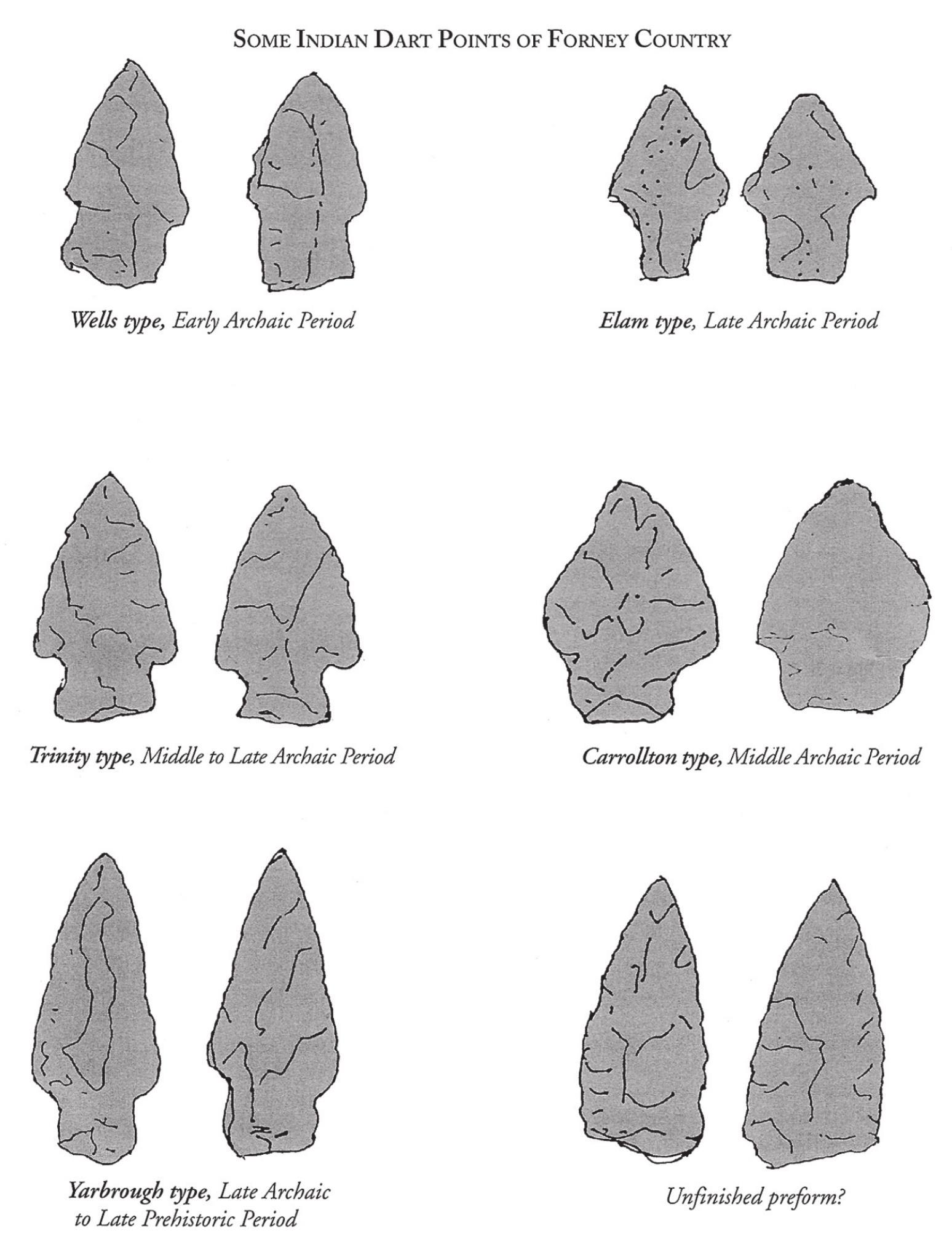
Much that is presumed about pre-historic Americans has been derived from their stone implements, which include some found in this area and that seem to pre-date the “Indian” tribe names that we recognize as Indians of our area and era.
Frank R. Lewis specified five or so distinct Indian camp sites from which artifacts had been found and also said that the best “projectile hunting sites” (arrow points, etc.) were “early on” found on high spots overlooking the Trinity River bottoms in our area and in surrounding counties.
It is believed that the first human inhabitants of the Forney area were the “Clovis” people (Paleo-Americans, Old Americans) and did not look like the “American Indians” of later years; they were nomadic hunters and gatherers.
Toward the end of the Archaic Period, there seems to have been a dramatic increase in the Indian population of this general area, and they were thought to have been less nomadic and more prone to establishing villages—or at least “longer staying” campsites.
Probably, the “bow-and-arrow” Indians came into more prominence as time passed, and this change was good for those of our area, since there was an abundance of “bois d’arc” trees, a great wood for the making of “bows.”
Many historians believe, at the end of the late Pre-Historic Period and the beginnings of the Historic Period, the Caddo Indians were the most powerful and numerous Indians of this area and moved a little more towards agriculture and made hunting more of a supplement to the “grown” and “harvested” foods.
And…..they were, at least at first, fairly welcoming to White settlers, and the settlers to them, even though these Indians had been known for torture and cannibalism towards their enemies. However, when the Caddos and Comanches allied, it was still terrible for the White settlers, who received vicious attacks.
By the time that Anglos began to “really” settle in, Texas Caddo Indian tribes were thinning out and were more part of “passing through” groups than the “settling” groups. But, they did at many times pose undeniable threats to the first Whites wanting to settle here!
1840s and 1850s: It is known that already way back in the mid-1500s, Spanish Conquistadores wandered through Texas and that Hernando de Soto’s expedition recorded written descriptions of what is thought to be the Three Forks Area.
And before Forney’s time, by the 1820s, Anglo immigration into parts of Texas increased greatly, including Austin’s Colony, 1823, promoted by the Mexican Government.
1839, Texas President Mirabeau Lamar ordered the expulsion of Cherokees from East Texas, and the rich land of the “mostly” peaceful Cherokee farmers was opened up for White settlement.
By the fall of 1841, Bird’s Fort (later Ft. Worth) was completed, and earlier in May of that same year, a large settlement of many Indians of various tribes was “burned out,” and they never tried to re-settle this area near present-day Arlington, Texas.
During 1845, there were still sporadic Indian threats, but by the 1850s, most encounters with Indians were friendly events.
It is thought that there were one or three White families living in what is now Kaufman County by 1837, but few were inclined to settle permanently until the Treaty of 1843 made the Indian threat a thing of the past.
In 1839, Warren Angus Ferris and Dr. William P. King started surveying this area for the purpose of settlement, and, despite great difficulties, not the least of which were floods of the lower lands, in 1841 produced a “block” of surveys which contained sections of land in present-day Kaufman, Rockwall, Dallas, Hunt, Collin, and Van Zandt counties.
The settling began, and here are some names (some more familiar than others) that we know came to the Forney area by or before 1850.
Auldridge, James, by 1850
Beckner, Benjamin, by 1848
Briscoe, Isaac, 1846
Briscoe, James R., 1846
Briscoe, Larkin W., 1846
Briscoe, Thomas, 1846
Briscoe, William, 1846
Coats, Samuel D., 1845
Conner, John R., by 1848
Donnell, Archibald M., by 1848
Edwards, Isaac, 1847?
Edwards, John, 1847
Haught, Samuel, 1845
Hendricks, Albert, by 1850
Holford, Jeremiah H., by 1848
Hull, Jacob C., by 1848
Jones, Fincher, 1847 Jones, Isaac, 1847?
Lawrence, John P., 1845
Ritter, Thomas W., by 1848
Rowe, Reuben W., by 1848
Scott, John, by 1848
Turner, Henry H., by 1848
Weaver, Wiley, D., by 1848
Our pioneer settlers by-and-large, who settled in deep East Texas, came from states of the “Lower South.” As might be expected, they brought with them the “plantation system” and the practice of “slavery.” However, the majority of Kaufman County’s first White inhabitants came here from the “Upper South”—Kentucky, Tennessee, Arkansas, Missouri, or Illinois! It seems that the majority were of “Scots-Irish” origin—American frontiersmen, small-scale farmers and stock raisers, whose families supplied the labor or hired others to help—and did not use “slave labor.” They were considered, and probably were, less cultured and less educated than many of the Eastern and Southern counterparts.
And here I will close for today, so that I can go out and mow, cut limbs, and dig holes on the Themer “back 2.20” and then go in for a little “light reading” of Shakespeare’s Sonnets or The Rise of Silas Lapham. If this article was a little disjointed and scattered, I apologize; early history did not always “get recorded” in chronological order!
- Log in or Subscribe to post comments.