
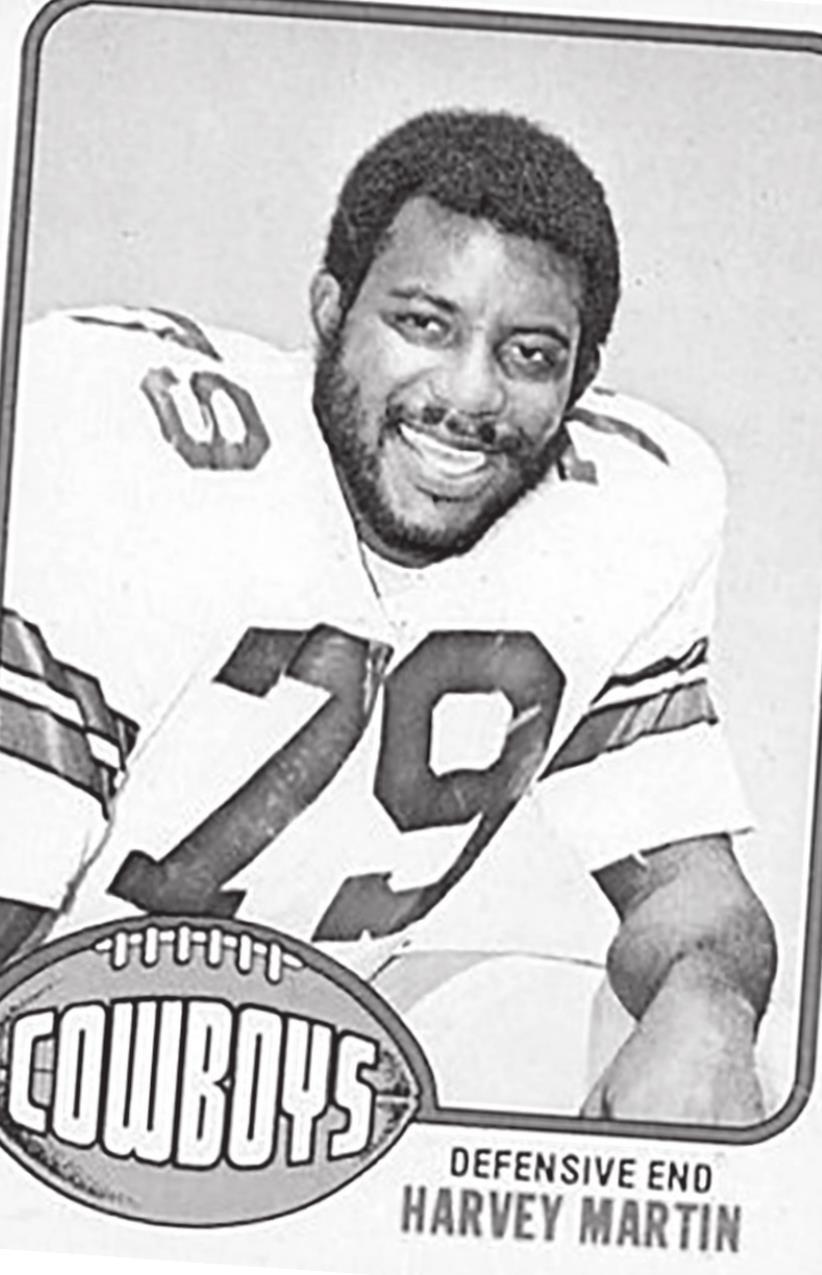
As I was reading a “secondary” newspaper (Dallas Morning News) in our household, I spotted a headline that stated, “African American Studies Approved,” and I was immediately transported back to my younger days at dear ol’ East Texas State University in Commerce, Texas. I had a casual acquaintance there, who later became a semi-friend, classmate, and sometimes lunch table partner when we both happened to dine at Central Cafeteria—Harvey Banks Martin—“All-American” at ET and “STAR” for the Dallas Cowboys, when they were still the COWBOYS!
Around 1971 or 1972 at East Texas State University, my Academic Adviser “advised” me to sign up for a course to give my Broad-Field Social Studies Degree more variety and suggested I take “Afro-American History,” as I remember it being called on campus. He said it was taught by Dr. Carrier, who was highly regarded at ET and in “academia” in general. So, off I went to talk to Dr. Carrier and then to sign up.
Funny Anecdote—Harvey Martin, already a “star” on the football field and immensely popular at ETSU, and I knew each other on a casual basis and happened to see each other walking into the classroom the first day of classes and sat by each other, making “small talk” until the professor walked in and immediately “got down to basics,” with his opening speech and then an introduction to the course and its requirements. IT SOUNDED PRETTY HARD, and being the grade-conscious person I was, I started squirming a little and jotting down information, while Harvey sat and smiled and did not take many notes.
As the semester progressed, the previous sentence basically described sitting by Harvey three times per week. About 3½ weeks into the course, Dr. Carrier announced the first test the “coming Friday” and gave some suggestions for additional readings outside what he had already assigned and about which he had lectured.
Friday arrived, and I sat down, sweating. Harvey came in moments later and said, “Themer, did you study?” I answered that I had, but I was afraid it might not be enough. He casually replied, “Not me; I’m not worried. It will all turn out like it is supposed to!” I “figured” he meant that he would get preferential treatment, since he was a football star!
After the bell signaled the end of the test, we walked out into the hall, where he asked, “How’d you do?” I told him I was a little worried and afraid I might have only made a “C.” He just grinned and shook his head!
Test papers were to be returned, GRADED, the next Wednesday, and I worried until that day arrived. Dr. Carrier lectured the first forty minutes of the class and then opened his brief case and laid papers upon his desk—and then spent about twenty minutes discussing several of the questions and what he had expected and how we might do better on the next exam. Then he walked about the room, placing our papers upon our desks. I looked at mine with a little relief, but also a little disappointment. I had made an “86” and was accustomed to 90s or higher!
Then I looked over at “Martin” and saw him looking down and saying, “Oh, me; oh me.”
The bell rang, and as we were exiting, Dr. Carrier said, “A word with you, Mr. Martin!” I left the room but waited outside, trying to hear what was being said—but I couldn’t!
Moments later, Harvey came out, shaking his head, not grinning. I asked what had been said, and this was his answer. “Mr. Martin, I hear you are about the best player on the football team. And I hear you will be an All-American. And I hear you will probably be a #1 draft choice after you graduate.”
And then Harvey continued with, “So, Themer, I started feeling better after those compliments!” But…. then he said, “Well, Mr. Martin, you had better change your attitude and take this course seriously and study, or you will not be graduating! You may go.”
Time passed, and it was time for the next test. Harvey had taken notes and not missed a class and been less “full of jokes and teasing” than usual in class. As we walked out the room, I asked him how he had done. His only answer was, “I’m pretty sure—better.” My answer was, “Me, too!”
When tests were returned, in a few days, we again walked out after class and stopped briefly to compare results. Harvey was much happier with his grade in the 80s on this 2nd exam, and I was, too, with mine in the 90s!
Harvey seemed to be a pretty smart guy, so I was not surprised when we saw each other at the semester’s end, and I found out he had finished with a “B” for the course, which included a paper we had to write!
And now, back to the idea of an “African American Studies course receiving final approval as an ‘elective’ course in high schools across the state.” I think it is a great idea, for in the course I took at ET we learned the true historical facts of the beginnings of slavery in the world and then in the United States. And we looked at impacts upon PEOPLE involved in all the facets and upon ECONOMY. And, we learned who did what to whom and what effects that system was still having upon people, not just in America but all over! Although I feel the above was the most important topic of that course, we discussed many other historical areas, too!
In our college classroom, there were males and females and Black, White, Brown, and all personality types involved in the lectures and discussions—and to the best of my knowledge, we all thought it was a great study—except the one young man, who chose to drop the class after a few weeks because he wanted to try to “teach the course,” and Dr. Carrier refused to let him!
The DMN article states that this course, after being proposed, has been, and still is, receiving widespread support from the State Board of Education and the Public.
I wish it had been taught when I was an instructor at FHS, and maybe I could have been a “guest lecturer” once each semester!
- Log in or Subscribe to post comments.