
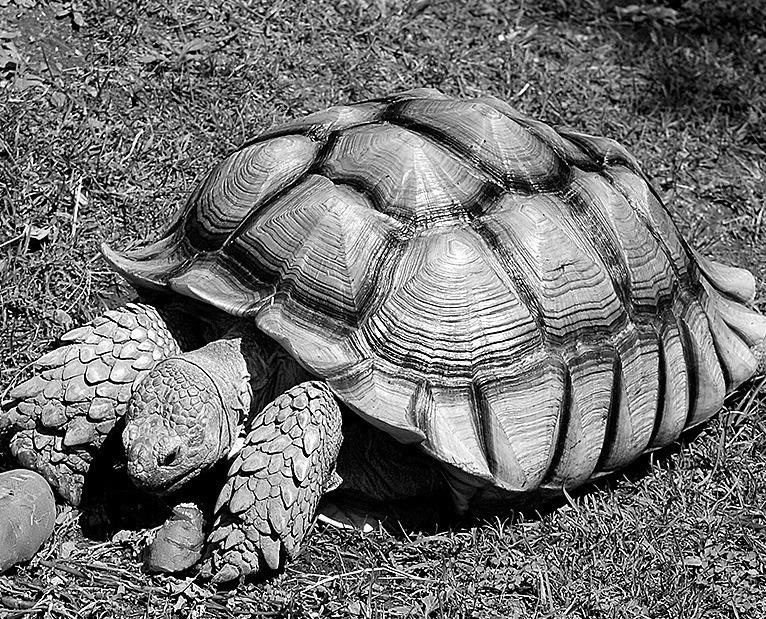
I have been entranced by TURTLES all my life, going back to when I caught my first snapper on a cane pole with Grandpa to the time Dad brought home a box turtle he found crossing the highway where the big flags now greet visitors to Forney, to the time I caught a soft-shell out of the pond at Green Forest Boy Scouts campsite near what is now Summerhaven Park, to the time I saw various types at the zoo and aquarium, to the time I had a “turtle box” with three of them in my yard on West Pacific by the C e m e t e r y and Wayland, Mark, Billy Wayne, and other “partners in crime” increased my numbers from three to seven to finally thirteen before I found out who and what was “going on!” I even had a small snapper and a small soft shell in an outdoor “clawfoot” bathtub for a while on Pacific.
But, I always wanted a BIG TURTLE, like the “giant ones” upon which I have seen children riding during various television shows.
So, when I heard about and then saw that LORENZO, which weighed about 200 pounds, had escaped from his owner’s Dallas yard area with creek access, I was immediately interested— especially when I found out that Dallas Animal Services had “picked one up” and that “Gabriel” had brought a photo and claimed him and said that he had often “digged out” but had always been soon found near the creek—but that this time he had been gone about five weeks!
The tortoise had been found by a person whose backyard was also close to the creek, and apparently the “escapee” had been happily burrowing and eating for quite some time before the discovery! Mr. “Gabriel,” according to the article, has five tortoises, Lorenzo being the 2nd largest.
A little research gave me the information that SULCATA TORTOISES are the 3rd largest in the world and can move quickly, dig under fences/walls, and eat various vegetables quite voraciously.
The Sulcata tortoise, a reptile, is also known by the name of African spurred tortoise and is 3rd in size only behind the Galapagos and Albrada giant tortoises. A Sulcata can reach 230 pounds or more, be nearly 3 feet in length, and live for more than 70 years!
In the wild, they are early morning and late afternoon foragers, as they are “crepuscular” (most active just after the sun rises and just before it goes down) and avoid heat, often digging burrows 10 feet in length to “stay cool.” They are usually found in semi-arid and arid environments and seem to be fairly common pets! They are herbivores and seem to favor “high in fiber” diets!
However, they are not exceptional pets and are considered “vulnerable” when considered for possible domestication—especially since they move and burrow quickly and grow to an extreme size—and they can be damaged by incorrect handling. Plus, literature says they can suffocate if flipped onto their backs and left for a long time.
So, much as I would like to be gifted with one, I guess I will just continue to admire them from afar!
- Log in or Subscribe to post comments.