
I will be the first to admit that I know little “real” information about our vehicles! When one seems to have a “major” problem, I open the hood and look at all the parts crammed into that little space as if I might know what is wrong or how to fix it—then I almost always take it to “Grady.” I think this is a common trait of many of my friends!
However, I do try to avoid problems with any preventative measures I can and try to fix the smaller issues by filling, tightening, replacing, or charging as I am able. And, I do consult my owner’s manual for “advice” and try to make myself do that before the “emergency” occurs.
This article is for guidance and/or to stimulate conversations with others or “readings” and “experimentations” in safe ways! Some of you much more “car smart” than I may even find this to be humorous!
Make note of the following areas to check periodically or if a warning light signals the need. Just yesterday evening, my “tire problem” light came on, and when I checked one tire’s air pressure, I found I needed
to add about 10 lbs. and will need to take it to the tire store to probably have a nail removed!
OIL LEVEL: It is easy to pull out the oil dipstick and check the markings to see if the level is too high (not often, unless someone added without paying attention to the amount) or too low (most often if the vehicle is older or has been driven without “service” long past the regular recommended interval). The “oil filler hole” is usually marked by “SAE” or “OIL.” You will probably need a spout or funnel to fill cleanly.
TRANSMISSION LEVEL: Just about exactly the same information applies to this area as to the oil……except it is marked “transmission” and seldom needs any addition.
RADIATOR FLUID LEVEL: (Probably should not do this “filling” while the warning light indicates the vehicle is “hot.”) Newer vehicles probably have a reservoir that is separate from the radiator itself and has markings to show the recommended level of the water/anti-freeze (coolant). Older vehicles, such as my ’88 Ranger, are filled directly into the “cooled off” radiator and must be guided by sight.
BRAKE FLUID LEVEL: Should be a reservoir cap with markings on it to guide filling if the brakes seem to not be working well. It does not take very much, usually! Get the brakes checked soon!
WINDSHIELD WASHER FLUID LEVEL: Another reservoir (usually plastic) that has a removable cap to allow filling. I do not think this can be “over-filled!” In colder weather, the fluid should have a type of antifreeze added to keep it flowing in below-freezing conditions.
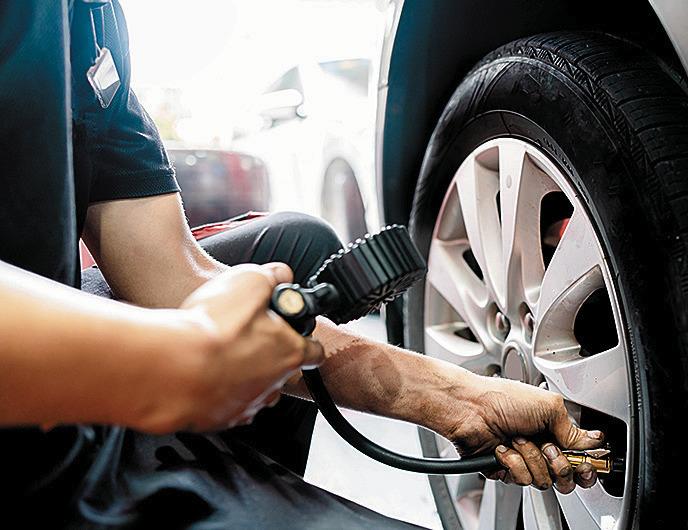
TIRE AIR PRESSURE LEVEL: On each tire is a “valve stem” that should have a small rubber or metal cap on its end. Remove the cap, and use an “air gauge” to see if the pressure is close to the recommended level, which should be posted on the inside of a door and/or in the owner’s manual. I have found that mechanics and tire salesmen often disagree with the owner’s manual. I keep our Ford Escape, Chevy Cruze, and Ford Ranger all at 35 p.s.i. pressure.
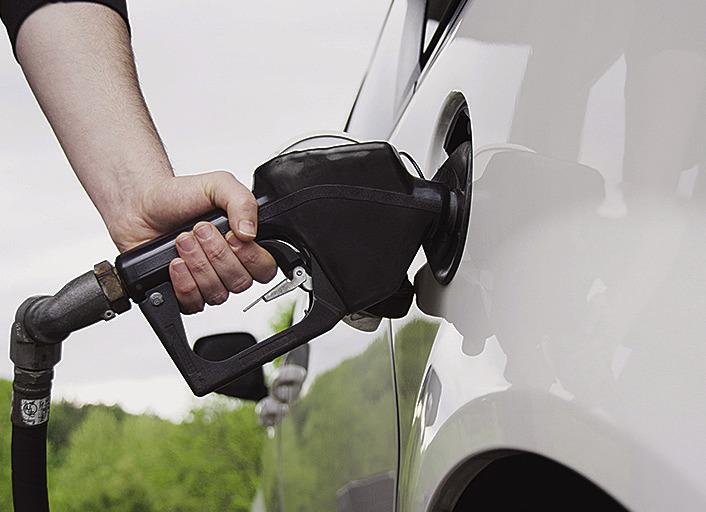
OCTANE Questions? My father always told me to not use a higher or lower octane level gasoline than was specified as best for the vehicle. He said that too low would make the engine “knock.” He was right, I found out the hard way, but added the correct level before any long-term problems occurred. He also said that using a higher than specified octane would make the vehicle
“need that level” from then on. I found out that he was not right about that, at least according to two mechanics I trusted during my “younger” years.
Is it all right to MIX OCTANES at different fueling times, especially if the recommended one is not available where you are? From all I can determine, the answer is “YES.” Supposedly, if you mix two differing levels equally, the octane becomes the “average” of the two. 96 octane mixed with 90 octane equally will produce 93 octane. Hardly ever can you not find the lower levels recommended, but some higher ones are harder to find in “out-of-theway” places.
And, fortunately, vehicle computer systems today are able to adjust the “timing” for octanes that are lower than recommended and will keep the engine from “knocking.” And the possibly diminished power levels will hardly be noticeable!
Should a person REV UP the Engine when first starting it and then “take off,” or should he start the engine and let it IDLE SLOWLY for a while? From all I can find out, it is best to start without pumping the accelerator pedal and then let the vehicle idle with no pumping for maybe 20 seconds to get the oil circulating throughout the engine so as not to cause extra wear and tear. Most newer vehicles don’t even need you to use the gas pedal at all when starting; the “computer” does all the “thinking” for you at just the right times and levels!
Can a driver trust the GAS GAUGE to be accurate when it signals the amount of gas left in the tank and how many miles can still be driven? The answer is, “Yes, for the most part!” What the gauge indicates, though, is “how much” is left according to the memory of the past driving record stored in the computer. My experience says to put gas into the tank whenever the gauge shows “below half full.”
Last bit of advice…..I like to carry a funnel, jumper cables, a 2’ by 2’ plywood square (to place the jack upon), an “air station” air pump, pliers, a small regulation gas can, a bottle or three of fresh water, and a flashlight with “flasher” in the trunk or cargo area of my vehicles.
Changing a tire is something my Dad demanded that I be able to do before he let me drive. Today, I would recommend calling a “road service” to do this or to drive, if possible, to a service station, tire store, or auto supplies store to get help and not try to do the job yourself—especially along a busy roadway. If you must change it yourself (and know how), drive onto the service or minor road and pull completely off the pavement and shoulder and use that 2’ by 2’ board for stability! Your spare is probably in the trunk, cargo area, or secured underneath the back of the frame.
DISCLAIMER: This article was written for advice and thoughtful reflection and should only be used as a guide. No two circumstances are exactly the same! Be prepared!
- Log in or Subscribe to post comments.