
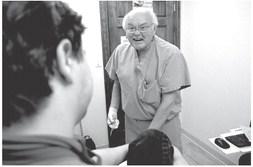
By Kim Krisberg and David Leffler, Public Health Watch Gary Reaves, who owns a plant nursery in the nearby town of Malakoff, sometimes dropped by with lunch for the front-desk staff. His home shares a fence line with Curran’s ranch.
“Athens is a very tightknit town,” Reaves said. “And a lot of it is because of people like Dr. Curran.”
Reaves has been Curran’s patient most of his life, first at Curran’s private practice and now at ETCC. “I’ve been blessed that I can afford it,” Reaves said. “But there’s a lot of people that cannot.”
Reaves, 67, was a drummer in his high school marching band and remembers seeing a young Curran on the sidelines during football games, checking players for injuries. Years later, when Reaves’ dad was diagnosed with cancer, Curran cared for him until he died. When Reaves’ brother passed away last year, Curran stopped by to check on his grieving patient, friend and neighbor.
In many ways, ETCC was expanding exactly as Curran, Mettetal and Robison had hoped it would. In just over a year, they’d opened two clinics, hired three more doctors, seen thousands of patients and launched a successful residency program.
But financially, they often lived month to month. Whenever their bank accounts got perilously low, they went back to their donors with detailed progress reports — and requests for more money.
Robison was rewriting the FQHC application with help from the Texas Association of Community Health Centers. He managed the clinics by day and worked evenings and weekends on the application. He said it was the hardest thing he’d ever done, including his four years in the Air Force.
It costs $80,000 to $100,000 a month to keep the clinics running. Their three donors fund about 75% of the operation, because about 70% of their patients either have no insurance, inadequate coverage or state Medicaid coverage, which in Texas comes with very low reimbursement rates.
The state typically pays ETCC about $28 for seeing a Medicaid patient. If it provides that same service to a privately insured patient, it can receive as much as $90.
While Robison wrestled with the FQHC application, it seemed the clinics might get a one-time shot of money from the state.
The Texas Legislature was divvying up $16 billion in federal COVID-19 relief money, and one idea was to use $200 million of it to reboot an incubator program the state had once offered to clinics that were trying to become FQHCs.
Curran traveled to Austin to lobby for the provision.
“[It] didn’t seem excessive in light of the accessto- care issues that Texas has,” he said. Not only was ETCC providing affordable care to thousands of uninsured Texans, it was also training young doctors who might end up staying in the rural region for good.
The Legislature passed the bill in October 2021, but it included $20 million, not $200 million, for the incubator program. Curran was still pleased. He assumed ETCC would be eligible for a big chunk of that money. They needed it to hire 10 more staff members, including another physician, medical assistants, a social worker and two full-time billers to negotiate with insurance companies, so they could capture as much revenue as possible.
But six months after the governor signed the spending bill, the Texas Department of State Health Services still hadn’t opened the application process. An agency spokesperson told Public Health Watch in May it was “in the process of hiring the program staff to begin the program.”
Meanwhile, ETCC was close to running out of money again.
“Glen and I just looked and we’re down to our last $50,000,” Curran said. “So, here we go again, we’re out of money. … It’s just such a pain, you know. It’s just very frustrating to have to do this when you know they’re sitting on $20 million.”
In a stroke of good timing, the Health Resources and Services Administration reimbursed ETCC $130,000 for uncompensated COVID-19 care the clinics had provided. It would help cover their costs for a couple of more months.
Robison had submitted their new application for FQHC status in March, and a reviewer had already been in touch, asking for a few clarifications. That was a good sign. But there was still no word about a site visit, the critical next step.
Curran and Robison went back to their donors. They got another $200,000 early this summer.
At the end of June, the state health department finally opened applications for the FQHC incubator funds. But Curran was stunned to see that applicants could ask for no more than $170,000, not the millions he had hoped for. This, he said, was “just a joke.” The clinics burned through that much in a few months.
Curran immediately called longtime state Sen. Robert Nichols, a Republican whose district includes Henderson County and who helped get the incubator money included in last year’s spending bill. Nichols had toured ETCC, and Curran calls him a “straight-up guy,” even though the two have disagreed on issues such as Medicaid expansion.
“I’ve told Robert Nichols he’s going to be my friend no matter what,” Curran said. “That’s a choice I’ve made. Now, I may not agree with him and we may have some strong conversation about everything before it’s all over. But he’ll still be my friend.”
Continued next week, in the November 3rd issue.
- Log in or Subscribe to post comments.