
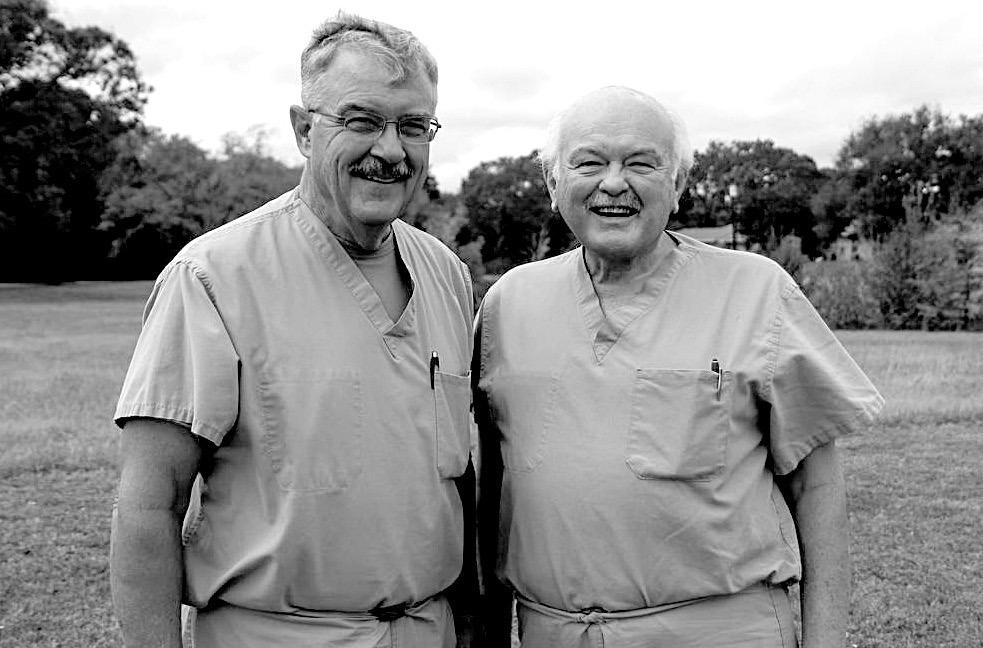
Retirement didn’t suit the doctors, anyway. They relished the joys and pace of small-town medicine: delivering a baby in the morning, stitching up a wound in the afternoon, making a house call after work.
“When you’re used to going 90 miles an hour, you kind of go stir crazy,” Mettetal said.
Robison had the technical skills to run day-to-day operations and navigate the clinic toward steady, longterm funding. The doctors had state and local connections that could help them patch together start-up funds and resources.
A group of physicians from their former private practice in Athens agreed to buy the 1,900-squarefoot Gun Barrel City building and lease it to them. They used an economicdevelopment loan to gut the old accounting office and create four small exam rooms.
The Dallas-based Ginger Murchison Foundation, whose namesake had deep ties to Henderson County, where ETCC is based, and Ardent Health, a privately owned company that operates health care facilities in Texas and other states, donated the $200,000 in seed money. A third funder — the East Texas Medical Center Foundation — stepped up after Curran drove one of its board members, a neurosurgeon and old friend, to Waco to visit a safety-net clinic similar to what ETCC was hoping to build. “So much in life, it’s not what you know, it’s who you know,” Curran said.
To save money, Curran and Mettetal worked without pay, on alternate days, six days a week. The clinic’s doors were open 10 hours on weekdays, six hours on Saturdays.
“We’ve never read anything in the Bible that talks about retirement,” said Mettetal, who, like Curran, grew up in rural Arkansas. The two met in medical school at the University of Arkansas, where they were both members of the Baptist Student Union. They still worship together at the First Baptist Church in Athens.
The Gun Barrel City clinic offered all the services that a private family practice would — preventive screenings, chronicdisease management, immunizations, lab work, prenatal care, child wellness checkups. They used some of their precious start-up money to bring in a pediatrician, Alice Splinter, two times a week.
But there was one big difference between this clinic and their old practice. Patients paid only what they could afford, even if that meant they couldn’t pay anything at all. Everyone was welcome.
Patients rolled in slowly at first, maybe a dozen a day.
But word quickly spread, and within a couple of weeks the clinic was booked. Some people traveled hours for the chance to see a doctor.
“It was like instantly, we had a full schedule, we were seeing patients left and right,” said Colby Estrada, the front-desk receptionist.
Estrada, 22, had always known that plenty of locals couldn’t afford health care. Her own father, a rancher, doesn’t have medical insurance. But she was shocked by the number of people who came through the door. It wasn’t uncommon for 80 to pass through in a single day.
Many had been forced to delay treatment for so long that their ailments had become more costly and complex to treat.
One woman had postponed surgery for an abdominal tumor because she had lost her job and health insurance. Some people had been living with untreated diabetes. Others were on the cusp of kidney failure. The doctors rarely went a week without seeing someone who lived in a car.
“It was mind-blowing,” Estrada said. “It’s just amazing to see us help everybody.”
Estrada’s father, Emilio, now comes to ETCC for care. So does her mother, Debra, who works a mile down the road at the local WIC office, which serves low-income women and children. Debra sends her WIC clients there, too.
“It’s so great to be able to say that right down the road there’s a clinic that’s sliding-scale, they don’t turn anyone away,” she said.
The doctors had always known Texans were suffering because they couldn’t afford health care. But seeing the reality of the unmet needs was unsettling.
“You delude yourself into thinking it’s not that bad,” Curran said. “It’s pretty bad.”
Continued next week, in the October 13th issue.
- Log in or Subscribe to post comments.