
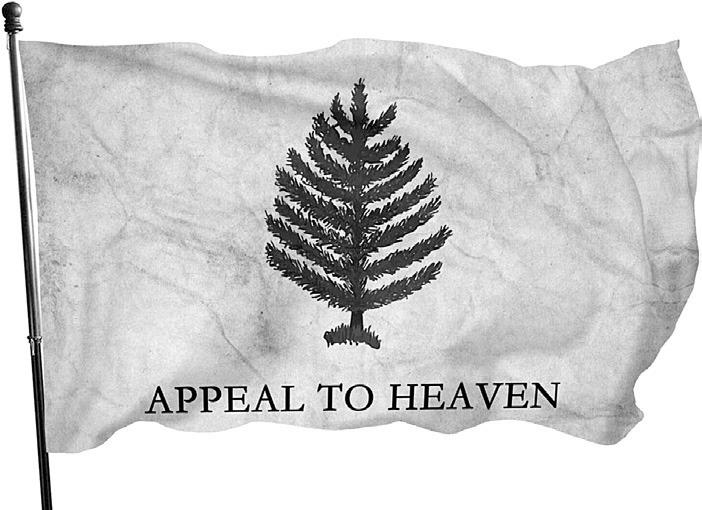

The Pine Tree Flag and the “Divine Right of Kings” Among the landmarks of history that led up to the American Revolution and independence, there were some lesser-known events long before the ones we all know about and hold dear. One of those events that occurred almost two years before the Boston Tea Party was an event that occurred in New Hampshire called the “Pine Tree Riot”. But before I get into that, I want to lay the background.
In the late 17th and 18th centuries, Great Britain had the most powerful navy in the world. A powerful navy relied on a constant supply of new ships, as well as raw materials, to keep ships at the ready. A lot of timber was required, but that was a commodity that became in short supply in England. Forests could be regrown in a few decades, but old growth trees could not. England turned to the new world to supply its navy with timber that had been all but depleted in the British Isles. In the southern colonies, giant oak trees could be found in abundance. However, one tree that was less plentiful was the giant white pine in the northeast. Sailing ships required tall masts to support sails and rigging, and the perfect tree for that job was white pine.
The basis for the King claiming ownership of pine trees in the colonies had its roots in the concept of the “Divine Right of Kings”. That meant the King had the right to claim ownership of just about anything, including trees: deer, boars, roads, bridges, even people as most of you saw in the movie Braveheart when King Longshanks decreed that his officers could even claim the wife of a Scottish man. My favorite philosopher, John Locke, refuted the “Divine Right of Kings” in chapter 14 of his Second Treatise on Civil Government which was published in 1690 as part of Two Treatises of Government. Locke’s philosophy, that mankind is free because God intended us to be free, provided a lot of the underpinning for the rebellion in the colonies that would become the American Revolution.
To give you a sense of time, the Pilgrims arrived at Plymouth Rock in 1620. Seventy- one years later, England included a mast-preservation clause in the 1691 Massachusetts Charter. That clause intended to ensure that 24-inch (61 cm) diameter white pine trees were set aside for use by the Royal Navy. Surveyors marked trees over 18 inches at the base with a broad arrow symbol. That meant that colonists could not cut that tree down for their own use. The so-called broad-arrow policy was never effectively enforced, and colonists cut mast pines for sale on the black market.
In New Hampshire, a similar law had been in effect since 1722 preserving any pine tree over 12 inches in diameter at the base. But fifty years later in 1772, things changed. Imagine you are a farmer living in the 18th century. You need lumber to build barns, workshops, storehouses, and to add on to your small house. Every time you open your front door you see a huge white pine tree right in front of you on your property. However, a broad arrow mark placed by the King’s surveyor serves as a reminder that the tree doesn’t belong to you. It belongs to a King, thousands of miles away across the ocean. Colonists simply ignored the decree and milled them anyway. That is until 1772 when a sheriff in New Hampshire started enforcing the arcane law. Mill owners and colonists were outraged. They took hold of the sheriff and his men, cut the ears, manes and tails off of their horses and paraded them through the streets. Again, this was two years before the more famous Boston Tea Party.
The pine tree became a symbol of the heart of a revolution, and the pine tree flag was born. It was a single pine tree on a white background, often with the words “An Appeal To Heaven”, a reference that meant that the King is not the final word. There is a higher power. And in a larger sense the American Revolution was an appeal to heaven, and the pine tree flag is a symbol of the resistance of the colonies to the concept of the “Divine Right of Kings”.
- Log in or Subscribe to post comments.